
Search Michigan Unclaimed Money
Michigan holds millions in unclaimed money for residents across all 83 counties. The Michigan Department of Treasury runs a free search tool where you can look up dormant bank accounts, uncashed checks, forgotten refunds, safe deposit box contents, and more. If your property was tax-foreclosed after 2020 and sold for more than you owed, you may also be owed surplus funds. Start your search below or browse by county or city to find local resources.
Michigan Unclaimed Money Overview
Michigan Unclaimed Money Search
The main place to look for Michigan unclaimed money is the state's online database run by the Unclaimed Property Division of the Michigan Department of Treasury. The site lets anyone search by name for free. You do not need to create an account to search. You do need an account to file a claim online, but that is also free. The state has returned more than $675 million to Michigan residents and businesses over the last five years.
To search, go to unclaimedproperty.michigan.gov and click the Search for Unclaimed Property link. Enter your first and last name. Try different name variations, including maiden names or former names. Also search for deceased relatives. The database covers property from banks, insurance companies, utilities, and other businesses that have lost touch with their customers.
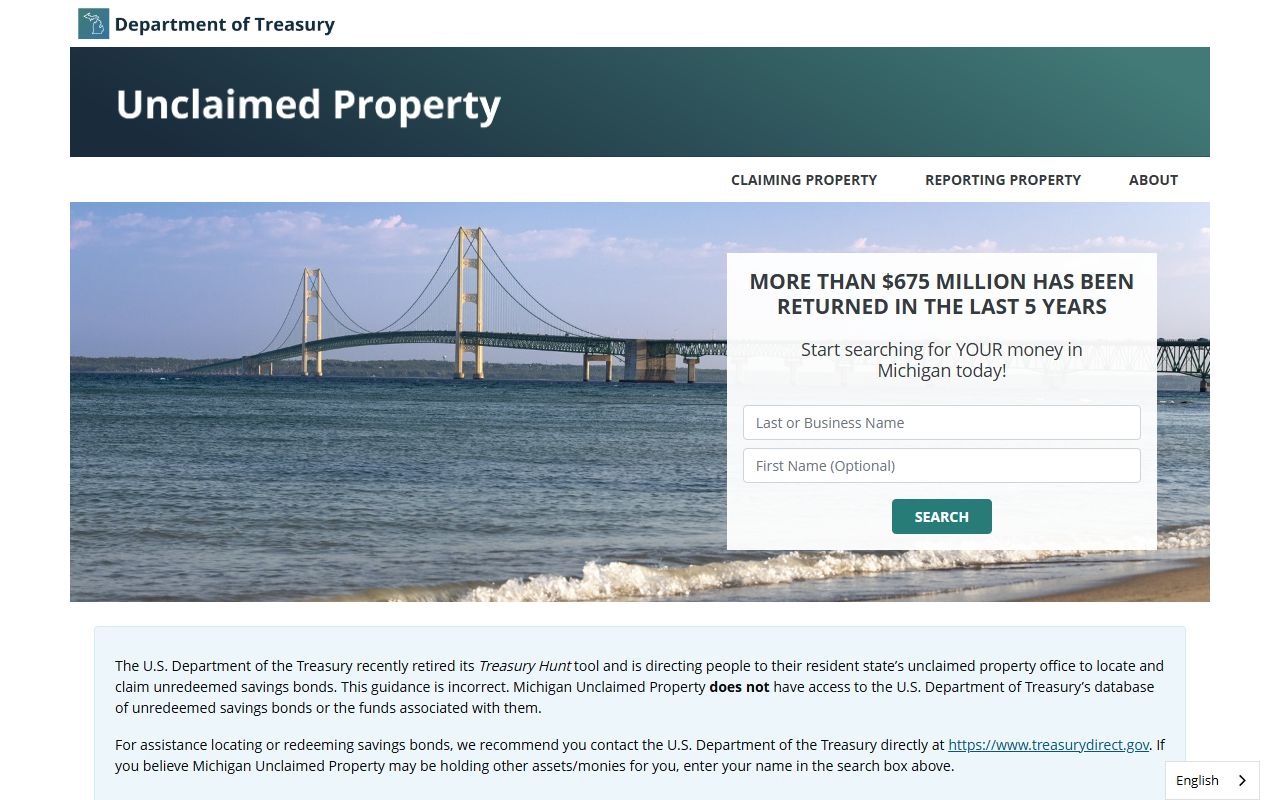
The Michigan Unclaimed Property Division website is the official starting point for any search in the state. The portal lets you search, file a claim, and check claim status all in one place.
What kinds of property show up in the database? The list is longer than most people think. Common types include checking and savings account balances, certificates of deposit, uncashed payroll checks, insurance policy proceeds, utility security deposits, stock dividends, and contents from safe deposit boxes the bank opened after years of no contact. The state holds this property until the rightful owner claims it. There is no deadline to claim. Your money does not go away.
Michigan law requires businesses to hand over dormant property after a set period of no activity. Most financial accounts go dormant after three years. The exact period depends on the type of property.
Note: Searching is free. No one should charge you to search the state database. If you find money, you can claim it yourself at no cost through the official state site.
How to Claim Michigan Unclaimed Property
Claiming unclaimed money in Michigan takes a few steps but is not hard if you follow them in order. The state processes thousands of claims each year and the online system makes it straightforward for most people.
First, search the database at unclaimedproperty.michigan.gov/app/claim-search. When you find a match, click to start the claim. You will pick your relationship to the property (owner, heir, business) and fill out your contact info. After you submit the claim online, you will get an email within 24 hours asking for supporting documents.

The claim search page at unclaimedproperty.michigan.gov lets you find property and start your claim right away.
Common documents the state needs to verify your claim:
- Government-issued photo ID (driver's license or state ID)
- Social Security card or letter with your SSN
- Proof of your current address (utility bill, bank statement)
- Death certificate and estate documents if claiming for a deceased person
You can upload documents through the state's secure portal. Most straightforward claims are paid within 60 to 90 days. More complex claims involving heirs or large amounts may take longer. Contact the Unclaimed Property Division at (517) 636-5320 or email TreasUPD@michigan.gov if you have questions about your claim status.
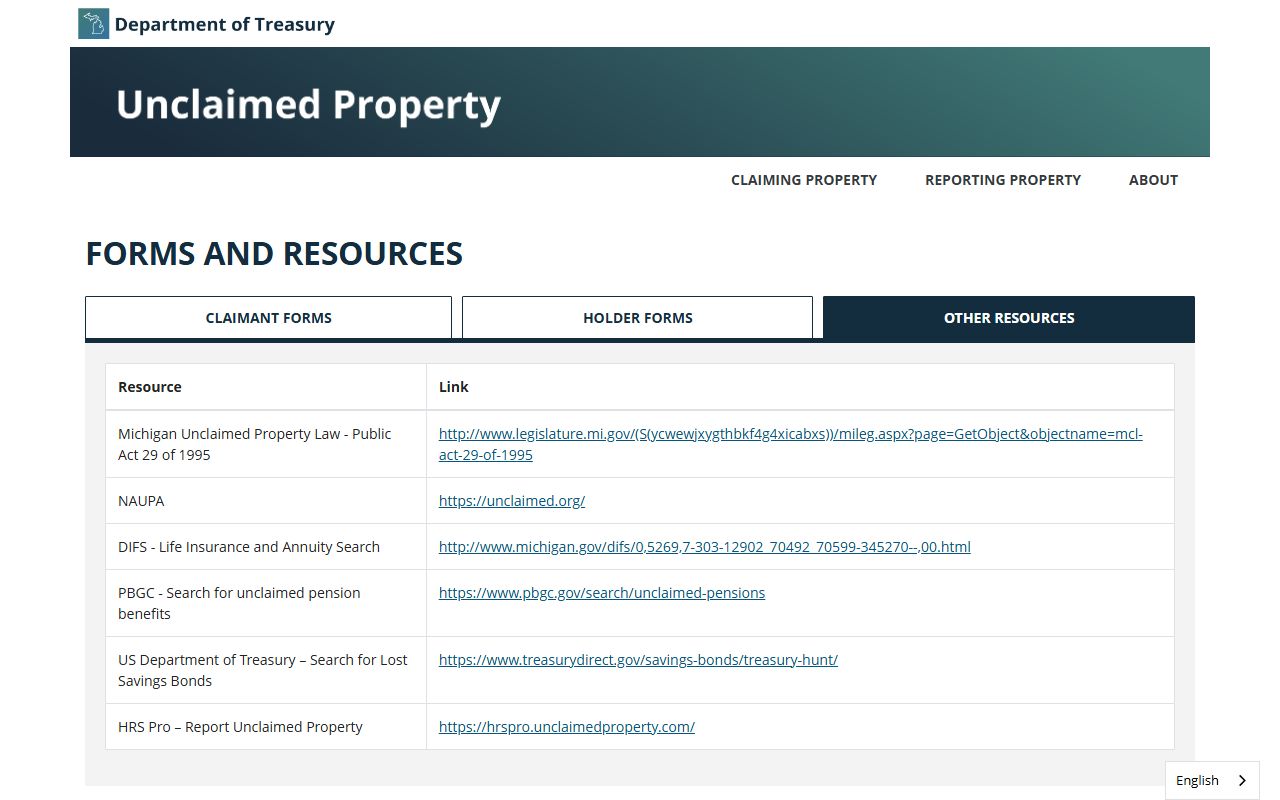
The forms and resources page has all the claim forms you may need, including Form 3433 for general unclaimed property inquiries.
Key Michigan unclaimed property forms include Form 3433 (Unclaimed Property Inquiry), Form 3165 (Holder Request for Refund), and Form 3277 (Claim for Refund of Unclaimed Property). You can find all of them at the state's forms page. The state also offers a document upload portal so you do not have to mail anything.
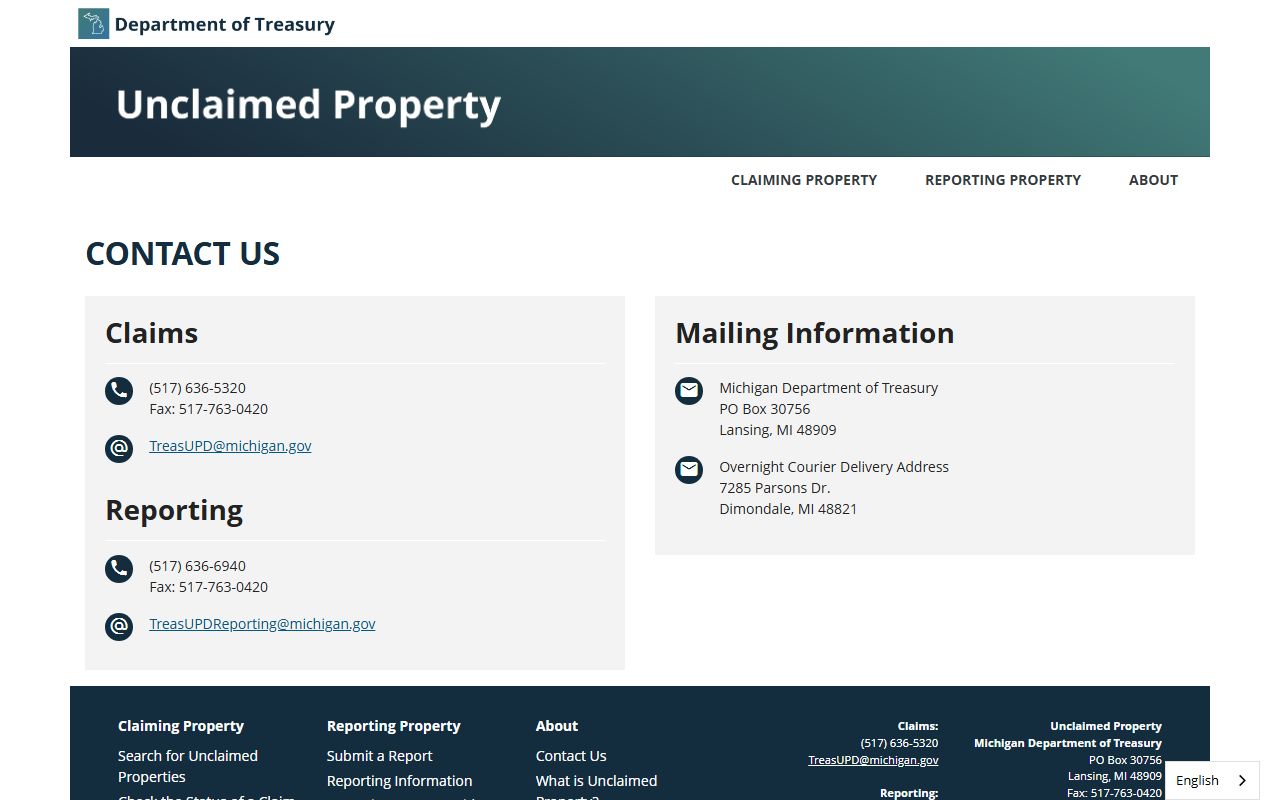
The contact page for the Michigan Unclaimed Property Division lists phone numbers, email addresses, and mailing addresses for claims and reporting questions.
Michigan Department of Treasury
The Michigan Department of Treasury oversees unclaimed property as one of many functions. The department handles state taxes, local government finance, and investment of state funds. The Unclaimed Property Division is one specific unit within Treasury that manages dormant property from businesses statewide.
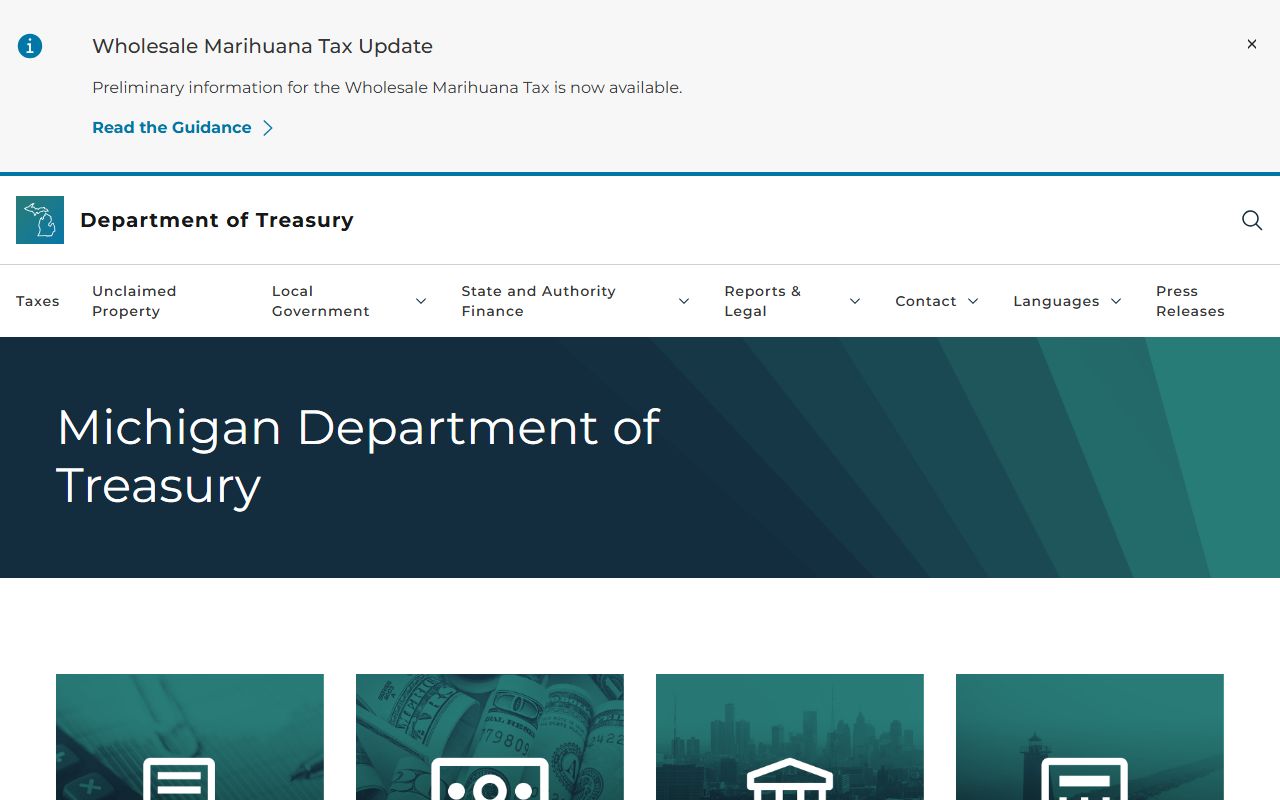
The Michigan Department of Treasury website at michigan.gov/treasury is the central hub for all state treasury functions, including the unclaimed property program.
Treasury contact details for unclaimed property claims:
- Claims phone: (517) 636-5320
- Reporting phone: (517) 636-6940
- Claims email: TreasUPD@michigan.gov
- Reporting email: TreasUPDReporting@michigan.gov
- Mailing address: P.O. Box 30756, Lansing, MI 48909
- Overnight: 7285 Parsons Dr, Dimondale, MI 48821
The department also handles tax collections and provides guidance to local governments and school districts. County treasurers work with the state Treasury on delinquent tax collections and property foreclosures under Public Act 123 of 1999 (MCL 211.78).
Note: The Unclaimed Property Division handles dormant financial accounts and similar property. Tax foreclosure surplus claims go through your county treasurer under a separate process.
Michigan Tax Foreclosure Surplus Funds
Beyond the state's unclaimed property database, Michigan residents may be owed money from a separate source: tax foreclosure sales. If your home or land was foreclosed for unpaid property taxes and then sold at auction for more than the taxes owed, the extra money belongs to you. This is called surplus proceeds.
In 2020, the Michigan Supreme Court decided Rafaeli, LLC v. Oakland County and held that counties could not keep surplus funds from tax foreclosure sales. The state then passed MCL 211.78t to create a formal process for former owners to claim those surplus funds. The law applies to foreclosures from 2021 forward.
The process under MCL 211.78t has four main steps. You file Form 5743 (Notice of Intention to Claim Interest in Foreclosure Sales Proceeds) with your county treasurer by July 1 of the year of foreclosure. The county responds by January 31 with Form 5744. You then file a motion with the circuit court between February 1 and May 15. The court sets a hearing date and issues an order. The county must pay within 21 days of the court order.
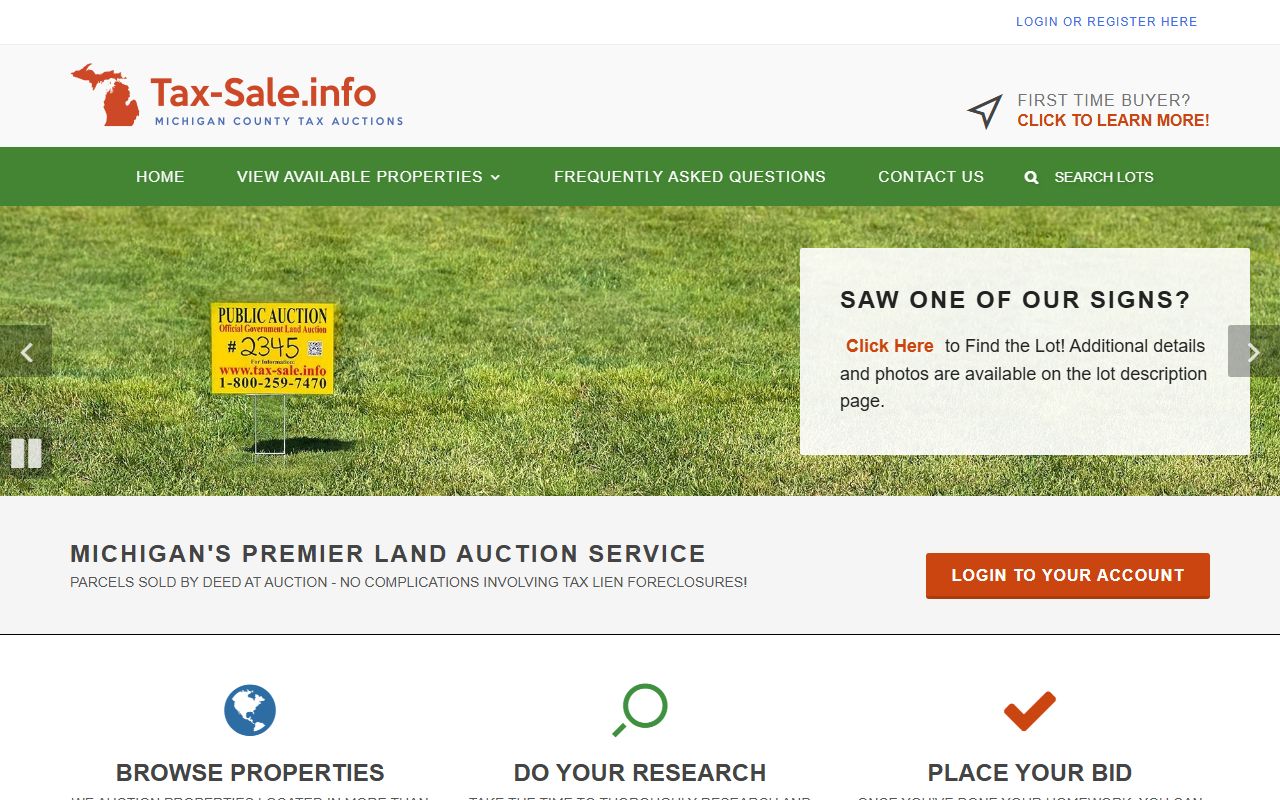
Tax-Sale.info is used by more than 74 Michigan counties to run their annual tax foreclosure auctions. You can see past auction results and search for upcoming sales on the site.
Wayne County uses a slightly different form. Wayne County residents use Form 6156 instead of Form 5743 and have different deadlines. Wayne County also has the most foreclosures in the state. Over $16 million in surplus funds was unclaimed in Wayne County alone between 2017 and 2019. The United Community Housing Coalition (UCHC) in Detroit offers free help to Wayne County residents trying to claim these funds. Call (313) 725-4560 for the UCHC Tax Foreclosure Hotline.

Michigan Legal Help has a step-by-step guide specifically for claiming leftover money after a tax foreclosure. It walks through every form and deadline.
Research shows that fewer than 10% of eligible property owners successfully navigate the surplus claim process without help. The deadlines are strict. A court case from Muskegon County confirmed that filing Form 5743 after July 1 permanently ends your right to claim surplus funds. Do not wait. If your property was foreclosed in 2021 or later, act before July 1 of the same year as the foreclosure.
Note: The July 1 deadline to file Form 5743 is strict. Missing it means losing your right to surplus proceeds, even if the sale generated significant funds above your tax debt.
Legal Help and Housing Assistance
If you need help with an unclaimed property claim or a tax foreclosure surplus claim, several organizations can assist you. Legal aid groups serve different parts of the state and most offer free help to people who meet income guidelines.
Legal Services of Eastern Michigan has two offices that serve a large part of the state. The Flint office at 436 S. Saginaw Street serves Genesee, Lapeer, St. Clair, and Huron counties. The Saginaw office at 301 E. Genesee Avenue serves Saginaw, Bay, Arenac, Clare, Gladwin, Gratiot, Isabella, Sanilac, and Midland counties. Both offices share a toll-free number: (800) 322-4512.
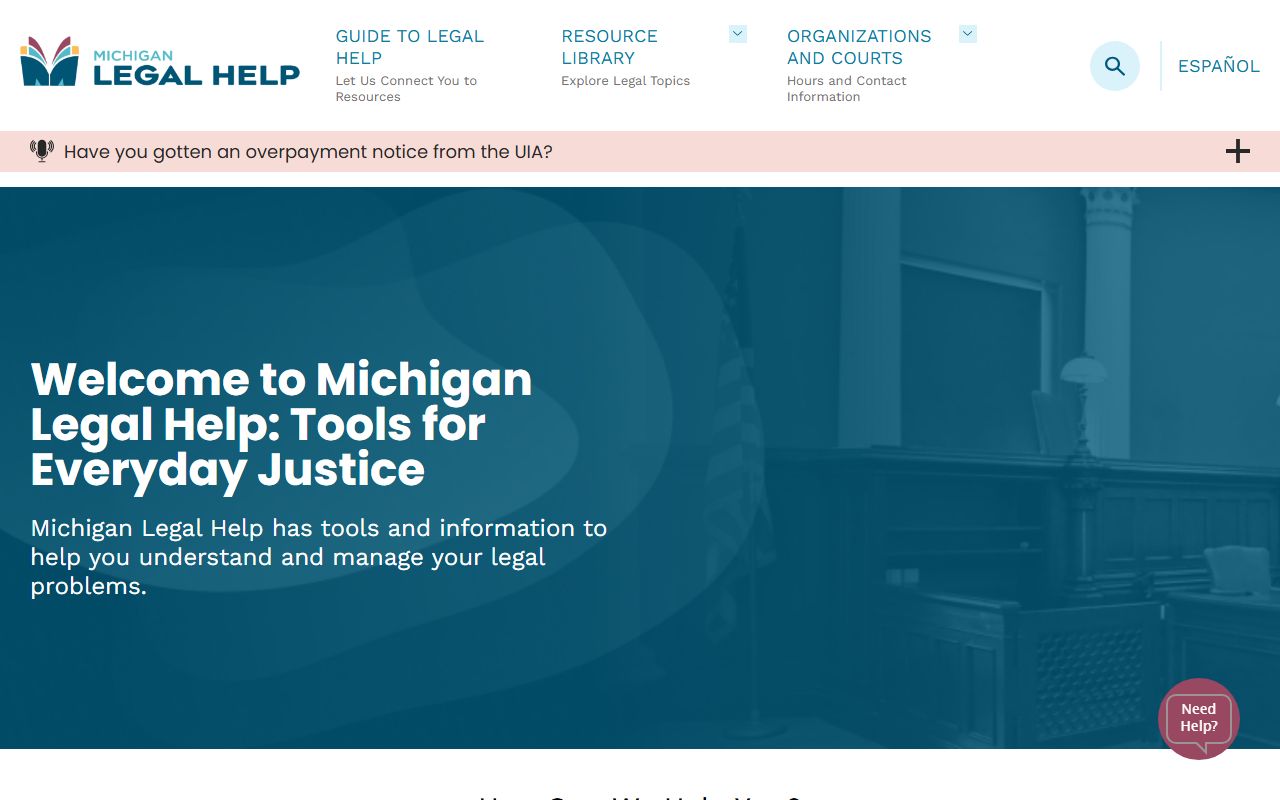
Michigan Legal Help at michiganlegalhelp.org offers free guides, forms, and resources for people dealing with property tax issues, foreclosure, and unclaimed property claims.
The State Bar of Michigan runs a lawyer referral service. Call (800) 968-0738 or visit lrs.michbar.org to get matched with an attorney who handles property or unclaimed funds cases. For Wayne County tax foreclosure claims specifically, UCHC at uchcdetroit.org provides free notary services and can help you complete Form 6156.
The Michigan Homeowner Assistance Fund (MIHAF) offers grants up to $25,000 to help homeowners who fell behind on property taxes due to COVID-19. The program covers delinquent taxes, mortgage, utilities, and other housing costs. To qualify, your household income must be below 150% of the Area Median Income and you must own and occupy the property.
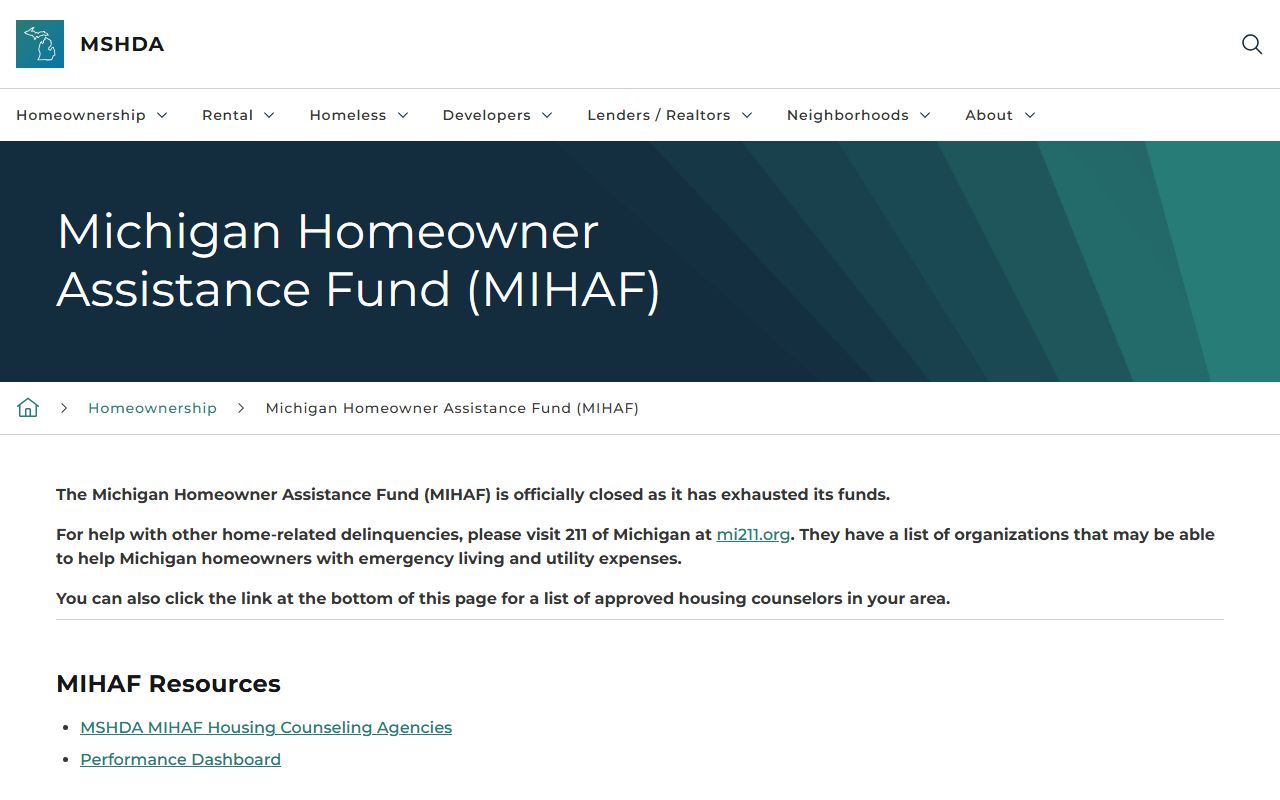
The Michigan Homeowner Assistance Fund at michigan.gov/mihaf provides grants to help homeowners avoid foreclosure. Delinquent property taxes are among the covered expenses.
Michigan Unclaimed Property Laws
Michigan law sets rules for how businesses must handle dormant property and when they must turn it over to the state. The core law is the Michigan Uniform Unclaimed Property Act. Businesses that hold dormant property must file annual reports with the state and transfer the property by November 1 each year. The state then holds the property indefinitely until the rightful owner comes forward.
Tax foreclosure rules are governed by the General Property Tax Act, MCL 211.78, which was overhauled by Public Act 123 of 1999. Under this law, unpaid property taxes become delinquent on March 1 of the year after they were due. The county treasurer takes over collection and the 3-year foreclosure process begins. Properties that are not redeemed by March 31 of the third year pass to the county.
Surplus proceeds claims follow MCL 211.78t, added after the 2020 Rafaeli decision. The law gives former owners and other interest holders a way to claim money left over after a foreclosure sale covers the taxes owed. MCL 211.56 covers interest rates and administrative fees on delinquent taxes (4% admin fee plus 1% monthly interest, increasing to 1.5% per month after forfeiture).
Michigan Article 10, Section 2 of the state Constitution protects property rights, including the right to surplus funds from a forced sale. The courts have cited this provision in several cases holding that counties must return excess proceeds to former owners rather than keeping them as a windfall.
Note: The law on surplus proceeds applies to foreclosures from 2021 forward under MCL 211.78t. Claims for pre-2021 foreclosures follow a different process and may be part of pending class action settlements.
Browse Michigan Unclaimed Money by County
Each of Michigan's 83 counties has its own treasurer's office that handles delinquent taxes and foreclosure surplus claims. Select a county below to find local contact info and resources.
Unclaimed Money in Major Michigan Cities
Residents of Michigan's largest cities can search the state database and also check with their city treasurer for local refunds or overpayments. Pick a city below for specific resources.