
Grand Rapids Unclaimed Money Search
Grand Rapids residents can search for unclaimed money through Michigan's free statewide database and through local city and county sources. Unclaimed funds can come from dormant bank accounts, old insurance policies, forgotten utility deposits, uncashed checks, and city tax overpayments. Grand Rapids is one of the few Michigan cities that collects a local income tax, so tax refunds are a common source of unclaimed money here. This page covers where to search, who to call, and how to file a claim at each level.
Grand Rapids Overview
Michigan State Unclaimed Property Search
Michigan's Department of Treasury collects funds that businesses and financial institutions can no longer locate the owners for. Once reported to the state, those funds are held indefinitely. The state has returned over $675 million to Michigan residents. There is no time limit on claims. You can search and file for free at any time.
Michigan's free statewide unclaimed property database is at unclaimedproperty.michigan.gov.
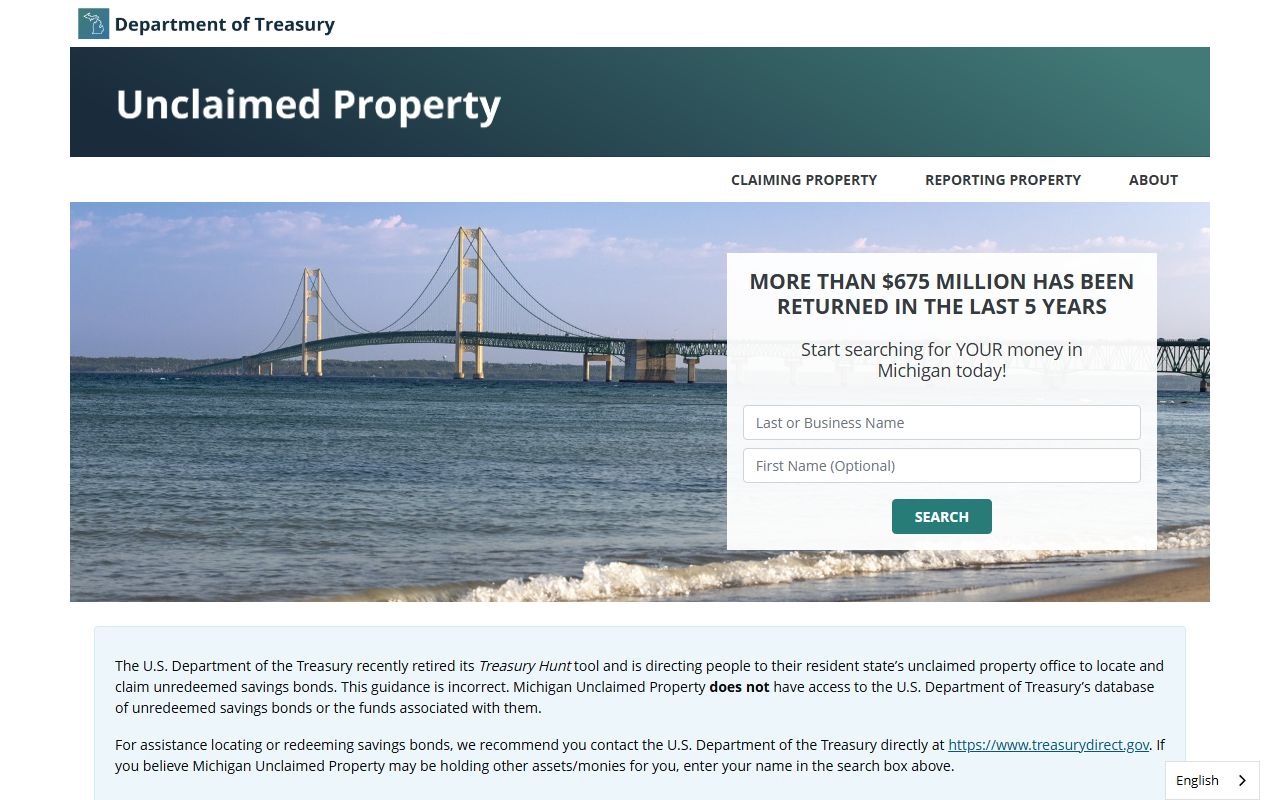
Search by name for free. Over $675 million has been returned to Michigan residents.
The search is simple. Enter your last name, or use a business name if you are searching for a company's funds. The results will show any matches the state has on file. If you find a match, click through to start a claim. You will need to confirm your identity and in some cases upload supporting documents. The state typically processes claims within 90 days. Questions can be directed to (517) 636-5320 or TreasUPD@michigan.gov. Kent County and the Grand Rapids metro area generate a significant share of unclaimed property in West Michigan, so it is worth checking even if you think you have no outstanding accounts.
City of Grand Rapids Finance Department
The City of Grand Rapids handles property tax billing, income tax collection, and other city financial accounts through its Finance Department. Grand Rapids is one of only a handful of Michigan cities that levy a local income tax. The rate is 1.5% for residents and 0.75% for non-residents who work in the city. If you overpaid city income tax in any year and never received a refund, that money may still be available. The city processes refund requests, but if a check goes uncashed it eventually gets forwarded to the state's unclaimed property program.
The city's website at grandrapidsmi.gov is where you can access tax forms and account information.

The Finance Department handles income tax returns, refunds, and city payment accounts.
| Department | Finance Department, City of Grand Rapids |
|---|---|
| Address | 300 Monroe Ave NW, Grand Rapids, MI 49503 |
| Website | grandrapidsmi.gov |
Property taxes in Grand Rapids follow the standard Michigan schedule. Summer taxes are billed July 1 and due by July 31. Winter taxes are billed December 1 and due by February 14. If you have an escrow account, your lender typically handles payment. If you pay directly and overpay, request a correction from the Finance Department before the end of the tax year.
Kent County and Delinquent Property Taxes
When Grand Rapids property taxes go unpaid, they are transferred to the Kent County Treasurer after March 1. At that point, the Kent County Treasurer takes over collection and charges additional interest. If taxes remain unpaid for three full years, the property can be subject to tax foreclosure.
Kent County Treasurer Peter MacGregor's office handles these delinquent accounts. You can reach the office at (616) 632-7500 or look up parcel information at kentcountymi.gov.
Mortgage foreclosures in Grand Rapids are different from tax foreclosures. Mortgage foreclosure listings for the Grand Rapids area are published in the Grand Rapids Legal News and go through the standard circuit court process, not through the Kent County Treasurer's office.
Tax Foreclosure Surplus Funds: Kent County Process
When a property sells at a Kent County tax foreclosure auction for more than the taxes owed, the previous owner has a right to claim that surplus. This is the result of the 2020 Michigan Supreme Court ruling in Rafaeli v. Oakland County, which confirmed that counties must return excess proceeds to former owners.
Kent County follows the standard Michigan process under MCL 211.78t. Here is how it works:
- Obtain Form 5743 (Notice of Intention to Claim Interest in Foreclosure Sale Proceeds) from the Kent County Treasurer's office or online.
- Submit the completed form by July 1 of the year following the foreclosure sale.
- If the county confirms surplus funds exist, you will need to file a motion with the circuit court to receive payment.
If you are not sure whether your former property sold at auction, or whether a surplus exists, call the Kent County Treasurer at (616) 632-7500. They can tell you the sale outcome and whether any funds are being held. Acting before the July 1 deadline is critical. Once that date passes, you may lose your claim for that cycle.
These surplus amounts can be substantial. If a property had significant equity above the tax debt, the former owner may be owed thousands of dollars. It is worth checking even if you did not expect a surplus.
Legal Aid and Free Help
Grand Rapids residents have several options for free or low-cost help with unclaimed property and tax foreclosure surplus claims.
- Michigan Legal Help at michiganlegalhelp.org provides free guides and self-help tools for unclaimed property, tax foreclosure, and surplus fund claims.
- State Bar of Michigan Lawyer Referral Service at lrs.michbar.org, phone (800) 968-0738. This service can connect you with a local attorney who handles tax or property matters.
- Michigan Homeowner Assistance Fund at michigan.gov/mihaf may be able to help if you fell behind on taxes due to a COVID-19-related hardship.
- Legal Aid of West Michigan serves the Grand Rapids area and handles housing and tax-related cases for qualifying low-income residents.
For larger claims, consider consulting a private attorney. Many handle surplus fund cases on a contingency basis, so you only pay if you get money back.