
Find Unclaimed Money in Detroit
Detroit residents can search for unclaimed money through Michigan's free statewide database at unclaimedproperty.michigan.gov. Unclaimed funds in Detroit come from many sources: dormant bank accounts, forgotten insurance payouts, security deposits, uncashed checks, and tax refunds. The City of Detroit Treasury has its own active program to find and return funds owed to residents, and Wayne County manages delinquent tax accounts and surplus funds from foreclosed properties. This guide covers each source and tells you exactly how to search, file a claim, and get your money back.
Detroit Overview
Michigan State Unclaimed Property Search
The Michigan Department of Treasury runs the statewide unclaimed property program. Any business that holds funds for a Michigan resident and loses contact with that person must report those funds to the state. The state then holds the money until the rightful owner comes forward. There is no deadline to file a claim. The state has returned over $675 million to Michigan residents and still holds hundreds of millions more.
Michigan's free statewide unclaimed property database is at unclaimedproperty.michigan.gov.
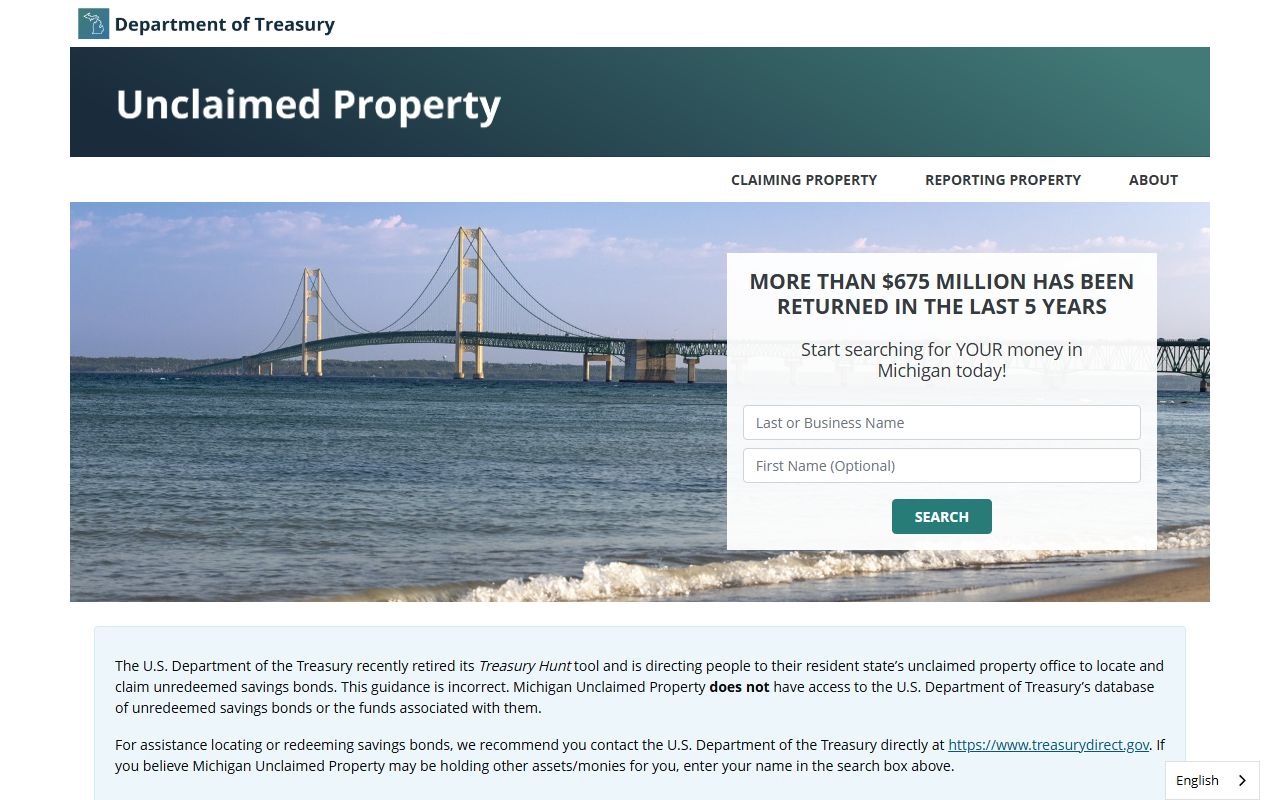
Search by name for free. Over $675 million has been returned to Michigan residents.
To search, go to the site and type in your last name, or try a business name if you are looking for a company's funds. The system will pull up any matches. If you find a match, you can file a claim right on the website. Most claims are processed within 90 days. You will need to provide proof of identity, and for larger amounts the state may ask for supporting documents. Phone support is available at (517) 636-5320 or by email at TreasUPD@michigan.gov.
Detroit is one of the state's largest cities, so a large share of Michigan's unclaimed property originates from Wayne County and the Detroit metro area. As of 2021, the state was holding 651 items totaling over $622,000 that were potentially payable to the City of Detroit itself. The Detroit Treasury has dedicated staff whose job is to track down and recover those funds. Individual Detroit residents should search the same database.
City of Detroit Treasury
Detroit's Office of the Chief Financial Officer oversees the city's treasury and tax collection operations. The city collects property taxes, income taxes, and various other fees. If you are owed a refund from the city for overpaid taxes or utility payments, you would need to contact the Treasury directly. The city has an income tax of 2.4% for residents and 1.2% for non-residents. Corporate taxpayers pay 2.0%. Overpayments on these accounts sometimes go unclaimed for years.
The city's website at detroitmi.gov is the starting point for most city-related financial questions.

You can pay bills and look up account status online at detroitmi.gov/pay.
| Department | Office of the Treasury, Office of Chief Financial Officer |
|---|---|
| Address | Coleman A. Young Municipal Center, Room 130, Detroit, MI 48226 |
| Mailing | P.O. Box 773178, Detroit, MI 48277-3178 |
| Phone | (313) 224-4179 |
| Hours | Monday-Friday, 8:00 AM - 4:30 PM |
| Website | detroitmi.gov |
If you believe you have a refund coming from the city's income tax division, call (313) 224-4179 and ask the tax division to look up your account. You may need to provide your Social Security number, the tax year in question, and a copy of your return. Refund checks that go uncashed are eventually turned over to the state's unclaimed property program.

The CFO's office also manages accounts payable and vendor payments, so contractors and service providers who were never paid should check here as well.
Wayne County and Delinquent Property Taxes
In Michigan, property taxes that go unpaid are transferred to the county treasurer after March 1 of the following year. For Detroit properties, that means Wayne County Treasurer Eric R. Sabree takes over. The county charges interest and fees on delinquent accounts. If taxes remain unpaid for three years, the property can enter tax foreclosure.
Wayne County uses an online payment portal for delinquent taxes. You can look up any parcel at pta.waynecounty.com. If you have a balance you did not know about, or if you think you overpaid, contact the Wayne County Treasurer's office directly at (313) 224-5990.
Wayne County also manages tax foreclosure auctions. If a Detroit property sells at auction for more than the taxes owed, the surplus funds belong to the former owner. Getting that money requires a separate legal process described below.
Tax Foreclosure Surplus Funds: Wayne County Form 6156
Wayne County follows a different process from most Michigan counties for claiming surplus funds after a tax foreclosure sale. This is important. Wayne County uses Form 6156, not the standard Form 5743 used elsewhere in the state.
Here is how the Wayne County process works:
- Get Form 6156 from Wayne County. The form must be notarized.
- Submit the completed, notarized form to Wayne County by March 31.
- Wayne County will notify you by July 1 if funds are available from your former property's sale.
- If funds are available, you must file a motion with the 3rd Circuit Court by October 1.
- If your motion is approved, you can expect to receive a check in early 2026.
The March 31 deadline is firm. If you miss it, you may lose your right to claim the surplus for that year. If you are not sure whether your former property sold for more than the taxes owed, call Wayne County at (313) 224-5990 and ask about surplus funds for your parcel.
This process was shaped in part by the 2020 Michigan Supreme Court ruling in Rafaeli v. Oakland County, which held that counties must return surplus proceeds to former property owners. Wayne County built its own procedures to comply with that ruling.
Free help with Form 6156 is available from the United Community Housing Coalition. Their Tax Foreclosure Hotline is (313) 725-4560. They can walk you through the form and the filing process at no charge.
Legal Aid and Free Help
Several organizations provide free or low-cost legal help to Detroit residents dealing with unclaimed money, tax issues, and foreclosure surplus claims.
- Michigan Legal Help at michiganlegalhelp.org has free guides on unclaimed property, tax foreclosure, and surplus fund claims. It is a good first stop if you are trying to understand the process.
- State Bar of Michigan Lawyer Referral Service at lrs.michbar.org, phone (800) 968-0738. They can connect you with a lawyer who handles property or tax matters.
- Michigan Homeowner Assistance Fund at michigan.gov/mihaf provides help for homeowners who fell behind on taxes or mortgage payments due to COVID-19 hardship.
- United Community Housing Coalition, (313) 725-4560, specifically for Wayne County Form 6156 and tax foreclosure questions.
If the amount at stake is significant, consulting a lawyer who handles property claims is worth the time. Many take these cases on contingency, meaning you pay only if you collect.