
Oakland County Unclaimed Money
Oakland County is home to over 1.3 million residents and is the origin of the landmark Michigan Supreme Court decision that changed how tax foreclosure surplus funds are handled across the state. This page covers how to search for unclaimed money through Michigan's state portal and how to claim surplus proceeds from Oakland County tax foreclosures through the treasurer's office in Pontiac.
Oakland County Overview
Michigan State Unclaimed Property
The Michigan Department of Treasury runs the state unclaimed property program. The search portal is at unclaimedproperty.michigan.gov and is completely free to use. Michigan has returned over $675 million to residents since the program began. Oakland County residents make up a significant share of those claims given the county's large population.
Unclaimed funds held by the state include dormant bank accounts, uncashed checks, unreturned security deposits, life insurance proceeds, and stock dividends that went uncollected. Businesses must report these assets to the state after the dormancy period passes, usually three to five years. Once the state holds the funds, they stay there indefinitely. There is no deadline to file a claim.
For help with a state unclaimed property claim, call (517) 636-5320 or email TreasUPD@michigan.gov.
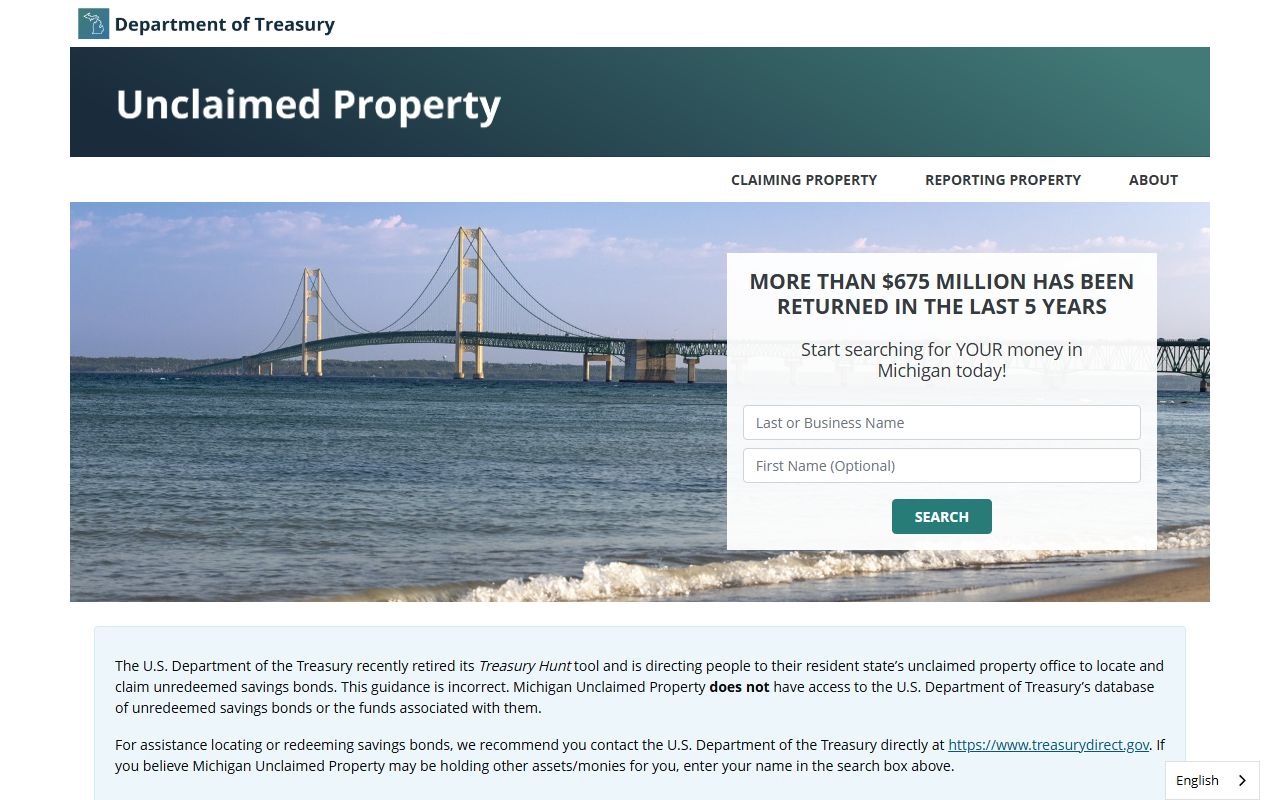
The state portal above lets you search for unclaimed property by name or business at no cost, with no account required.
Oakland County Treasurer
Oakland County Treasurer Robert Wittenberg oversees property tax collection, delinquent tax accounts, and the county's tax foreclosure process. The office is located at 1200 N Telegraph Rd, Dept 479, Pontiac, MI 48341-1036. Reach the office by phone at 248.858.0611 and press Option 7 for property tax questions. The county's main website is oakgov.com.
Oakland County is one of the most active counties in Michigan for delinquent property tax collection. In 2022, the county turned over 41,498 delinquent properties to the collection process. By March 1, 2024, 4,915 properties had been forfeited to the county treasurer. These numbers reflect the scale of the process in Oakland County and the volume of potential surplus claims that arise each year after the auctions.
If you believe your property sold at auction for more than what was owed, contact the treasurer's office and ask for information on the specific parcel. Staff can tell you the sale price and total amounts owed, which you need to determine whether a surplus exists. You should also confirm whether Form 5743 was filed in time before assuming a claim is viable.
Rafaeli LLC v. Oakland County: The Landmark Case
Oakland County is where the most important Michigan property law case in recent decades originated. Rafaeli LLC v. Oakland County was decided by the Michigan Supreme Court on July 17, 2020. The case changed how surplus proceeds from tax foreclosures are handled across all 83 Michigan counties.
Before the ruling, counties kept all proceeds from tax foreclosure sales, even when the sale price far exceeded the amount owed in back taxes. The Michigan Supreme Court held that this practice was unconstitutional. The court ruled that the government's retention of surplus proceeds amounted to an unconstitutional taking of private property. The former owner retains a vested property right to those surplus proceeds, even after foreclosure.
The court reasoned that common law recognizes the former owner's right to surplus proceeds from a forced sale. The property owner does not lose all rights to the property simply because it enters the forfeiture process. Forfeiture does not transfer title or give the county treasurer rights over any value above the tax debt. Michigan Constitution Article 10, Section 2 protects the former owner's property right to whatever proceeds exceed the debt.
This ruling led directly to the enactment of MCL 211.78t, which created the current formal process for claiming surplus funds from tax foreclosure sales. Every Michigan county must follow this process. Oakland County, having been the defendant in the landmark case, now applies these procedures to its own foreclosures.
Tax Foreclosure Surplus Funds
Under MCL 211.78t, former property owners have the right to claim surplus proceeds from tax foreclosure sales that occurred on or after July 17, 2020. The process in Oakland County follows the statewide framework precisely.
Oakland County Step-by-Step Surplus Claims Process
The claims process begins with Form 5743. You must file this Notice of Intention to Claim Proceeds with the Oakland County Treasurer by July 1 of the year following foreclosure. This deadline is strict and is enforced by courts. Filing late means you forfeit your right to the surplus. This form must be filed before you know whether a surplus exists.
After the auction runs, typically in the summer and fall, the county sells the foreclosed properties. By July through November the sales take place. By January 31 of the following year, the county completes Form 5744 and notifies all claimants of the proceeds. This is when you learn whether a surplus exists and what amount may be available to you.
From February 1 through May 15, claimants who received a Form 5744 notification can file a motion with the Oakland County Circuit Court. The court then holds a hearing to determine the priority of claims among all parties who filed valid notices. Valid claimants can include former owners, lienholders, and others with a legal interest in the surplus. The court issues an order setting out who gets paid what amount and in what order.
Once the court order is entered, the Oakland County Treasurer must remit payment to each claimant within 21 days. All notifications in the Oakland County process are sent by certified mail at each stage, so keep your address current if you have a pending claim.
Michigan Tax Foreclosure Timeline
Michigan's three-year tax foreclosure process applies in Oakland County just as it does throughout the state. Oakland County publishes a detailed version of this timeline for property owners who are behind on taxes.
Year One - Delinquency: Taxes become delinquent March 1 and transfer to the county treasurer. A 4% administrative fee is added, plus 1% per month interest. June 1 notice is mailed. September 1 a second notice goes out. October 1 a $15 notification fee is added.
Year Two - Forfeiture: The property is forfeited to the county treasurer March 1. A minimum $235 fee is added. The interest rate increases to 18% per year, retroactive to March 1 of the prior year. Through June to January, additional fees are added for property visits ($40), lienholder notification ($15), and newspaper publication ($10). An administrative show cause hearing is scheduled in January or February. A judicial foreclosure hearing follows if the owner does not pay.
Year Three - Foreclosure: March 31 is the final day to pay all amounts and stop foreclosure. April 1, ownership transfers to the Oakland County Treasurer. The property goes to auction and if it sells for more than what was owed, the surplus claim process under MCL 211.78t begins.
Legal Aid Resources
Oakland County residents have access to strong legal resources for unclaimed money and foreclosure matters.
Michigan Legal Help at michiganlegalhelp.org has guides specific to the surplus claim process, including how to fill out Form 5743 and how to file a circuit court motion. The site is free and does not require an account.
Oakland County Circuit Court handles all surplus fund motions for Oakland County. Court filings must be made between February 1 and May 15 following the auction year. If you need help with the court motion, consider contacting a local attorney through the State Bar referral service.
State Bar of Michigan Lawyer Referral Service is at (800) 968-0738 or lrs.michbar.org. Many Oakland County attorneys handle property and foreclosure cases and are familiar with the Rafaeli ruling and MCL 211.78t procedures.
Michigan Homeowner Assistance Fund (MIHAF) at michigan.gov/mihaf provides financial help for homeowners facing foreclosure. Check the site for current eligibility rules.
Cities in Oakland County
Several large cities in Oakland County have their own dedicated pages on this site. Use these links to find city-specific unclaimed money information.
Nearby Counties
Oakland County is surrounded by several counties in southeast and central Michigan. Each follows the same MCL 211.78t surplus process and has its own treasurer's office.