
Access Livingston County Unclaimed Money
Livingston County residents can search for unclaimed money through Michigan's free state database, and former property owners with qualifying tax foreclosures may be owed surplus funds from auction sales where the price exceeded the taxes and fees. This fast-growing southeast Michigan county follows Michigan's standard three-year foreclosure process, with properties auctioned through the statewide Tax-Sale.info platform.
Livingston County Overview
Michigan State Unclaimed Property Search
Michigan's Department of Treasury maintains a free unclaimed property database at unclaimedproperty.michigan.gov. The system holds dormant bank accounts, old savings bonds, forgotten insurance proceeds, uncashed checks, utility deposits, and other abandoned financial assets. Search by name. No fee. The state has returned more than $675 million to residents, and many people find money they did not know they were owed.
Contact the state unclaimed property division at (517) 636-5320 or TreasUPD@michigan.gov. Staff can confirm whether a database match belongs to you and walk you through submitting a claim. Most claim types are handled online and do not require visiting an office.
Michigan's free statewide unclaimed property search is available at unclaimedproperty.michigan.gov.
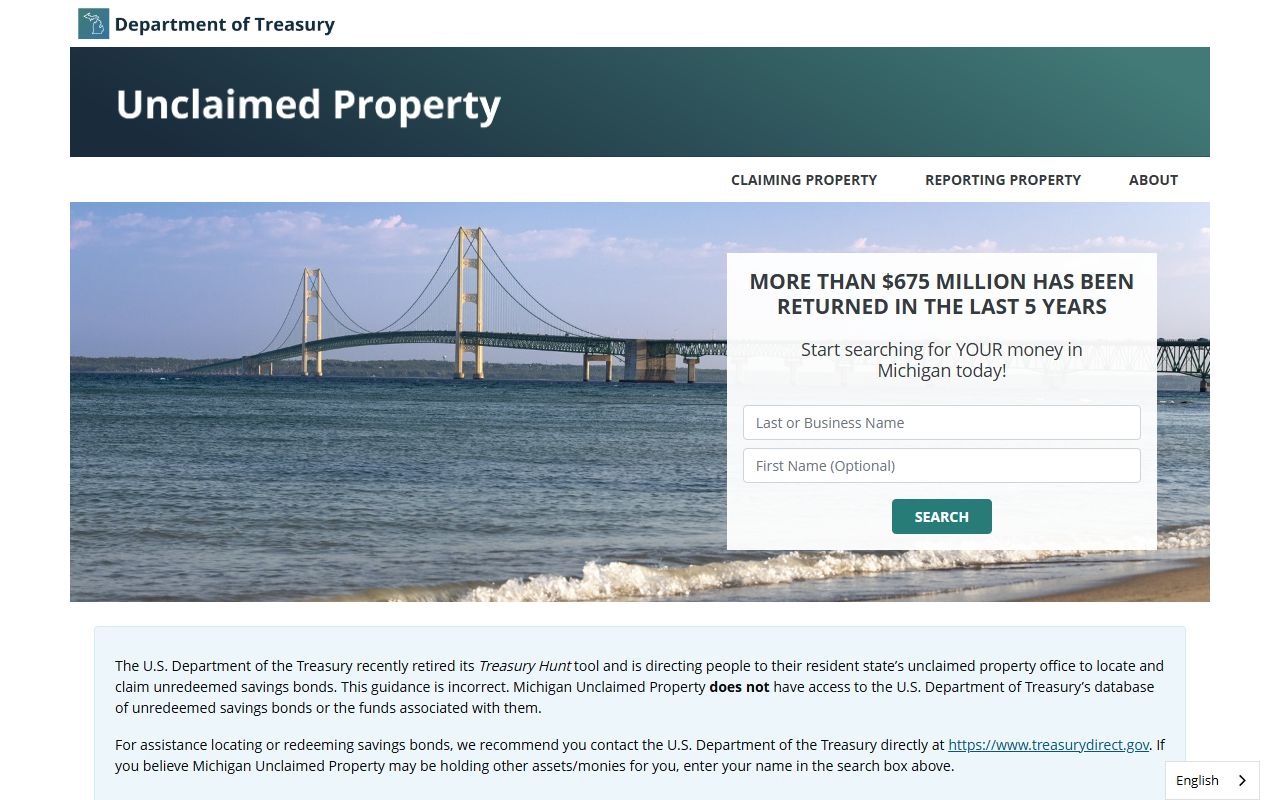
Search by name at no cost. No account required.
You can search for deceased relatives too. If a family member had Michigan accounts that were never closed, those funds may still be held by the state. There is no deadline to file once money is in the state system.
Livingston County Government
Livingston County is based in Howell and has seen steady population growth as a southeastern Michigan county close to the Ann Arbor and Detroit metro areas. The county website at livgov.com provides access to county departments and services, including the Treasurer's office.
The Livingston County main website provides access to county departments and services, including the Treasurer's office.
Find current contact information, office hours, and department links at the county site.
The Livingston County Treasurer is the Foreclosure Government Unit (FGU) responsible for delinquent property tax collection and the annual tax foreclosure auction. For specific account questions, call the Treasurer's office in Howell directly. The county follows all standard Michigan Department of Treasury guidelines for foreclosure proceedings.
Tax Foreclosure Surplus Fund Claims
Under MCL 211.78t, former owners of properties foreclosed in 2021 or later can claim surplus proceeds from the auction sale. Surplus is the portion of the sale price that exceeded the total taxes, fees, and interest owed at the time of foreclosure. This money belongs to the former owner, not the county.
The claim process works as follows:
- File Form 5743 with the Livingston County FGU (the Treasurer's office) by July 1 of the year the property was sold at auction.
- The FGU reviews the claim and responds using Form 5744 by January 31 of the next year.
- If not resolved, file a motion in the Livingston County Circuit Court between February 1 and May 15.
- Attend a court hearing. If the claim is approved, payment follows within 21 days of the court order.
The July 1 deadline for Form 5743 is not flexible. If you miss it, you lose the right to claim surplus under MCL 211.78t for that sale. Mark this date on your calendar and file early if possible. The form itself is not complicated, but gathering supporting documents can take time.
For foreclosures before 2021, the Rafaeli v. Oakland County (2020) ruling from the Michigan Supreme Court established that retaining surplus without compensation was unconstitutional. Former owners from that period may still have legal options depending on the timing and details of their case. A legal aid organization or attorney can help assess eligibility.
Michigan Tax Foreclosure Timeline
Michigan's three-year tax foreclosure process has defined stages with specific costs and deadlines at each level.
Taxes that go unpaid by March 1 of the year after the due date become delinquent. A 4% administrative fee applies and interest runs at 1% per month from the original due date. The county treasurer takes over collection from the local township or city at this point. The owner can still pay and resolve the issue without further consequences, but the balance grows monthly.
If the balance remains unpaid by the next March 1, the property enters forfeiture status. The interest rate increases to 1.5% per month. A title search fee and recording fees are added to the total. Forfeiture does not mean the property is lost. The owner still has time to pay the full amount and keep the property. Most people who pay during forfeiture do so because they finally have the funds or found out the deadline was near.
If no payment is made, the county files for foreclosure in circuit court. Once the judge enters the foreclosure judgment, the owner's rights end. The county takes title and prepares the property for the annual auction. Given Livingston County's higher property values relative to the state average, auction prices frequently exceed the delinquent tax balance, which can mean significant surplus funds for former owners.
Tax Auction in Livingston County
Foreclosed properties in Livingston County are listed and auctioned through Tax-Sale.info. You can browse available properties and register to bid at tax-sale.info, or call 800-259-7470. Property lists are typically posted around July 1 ahead of the summer auction.
Michigan law requires a Right of First Refusal step before properties go to public auction. The State of Michigan has first access, followed by local units of government such as townships and cities. Only properties not acquired through that process proceed to public bidding. Given Livingston County's growth and property values, local governments sometimes acquire parcels before they reach public auction.
At the first auction, the minimum bid must cover all taxes, interest, fees, and costs. If the property does not sell, it may go to a second auction at a lower minimum. Any sale price above the minimum becomes surplus under MCL 211.78t for qualifying foreclosures.
Legal Help for Livingston County Residents
Several resources are available for residents who need guidance on unclaimed money, surplus claims, or the tax foreclosure process.
Michigan Legal Help offers free guides at michiganlegalhelp.org. The guide on claiming leftover money after a tax foreclosure covers Form 5743, the FGU response process, and the circuit court steps. It is written in plain language and is easy to follow.
Legal Services of Eastern Michigan (LSEM) serves Livingston County at (800) 322-4512 or lsem-mi.org. Free civil legal help is available to qualifying individuals for housing, tax foreclosure, and surplus claim matters.
The State Bar of Michigan Lawyer Referral Service can connect you with a local attorney at (800) 968-0738 or lrs.michbar.org. An initial consultation is typically available at a low flat fee.
The Michigan Homeowner Assistance Fund (MIHAF) at michigan.gov/mihaf may have programs to help homeowners avoid foreclosure by catching up on delinquent taxes. Check current program availability on their site.
Cities in Livingston County
Livingston County has no cities with populations above 100,000. Howell is the county seat and largest city. Brighton, Fowlerville, and Pinckney are other notable communities. All residents use the Livingston County Treasurer's office for delinquent tax and foreclosure matters.
Nearby Counties
Livingston County is in southeastern Michigan and borders several counties in the greater Detroit and Lansing metro region.