
Kent County Unclaimed Money Search
Kent County residents can search for unclaimed money through Michigan's free state database and may also be owed surplus funds from tax foreclosure sales where proceeds exceeded what was owed on the property. The Kent County Treasurer handles delinquent tax collection and manages the county's auction process for foreclosed properties, so knowing how each program works can help you find and recover what is yours.
Kent County Overview
Michigan State Unclaimed Property Search
The Michigan Department of Treasury runs a free search tool at unclaimedproperty.michigan.gov. This database holds dormant bank accounts, uncashed checks, forgotten insurance payouts, utility deposits, safe deposit box contents, and other abandoned assets. You search by name only. No fee. No account needed. Michigan has returned more than $675 million to residents, and a quick search takes only a few minutes.
To reach the unclaimed property division, call (517) 636-5320 or email TreasUPD@michigan.gov. Staff can confirm whether a result belongs to you and walk you through the claim steps. They are familiar with the most common questions and can help you gather the right documents before you file.
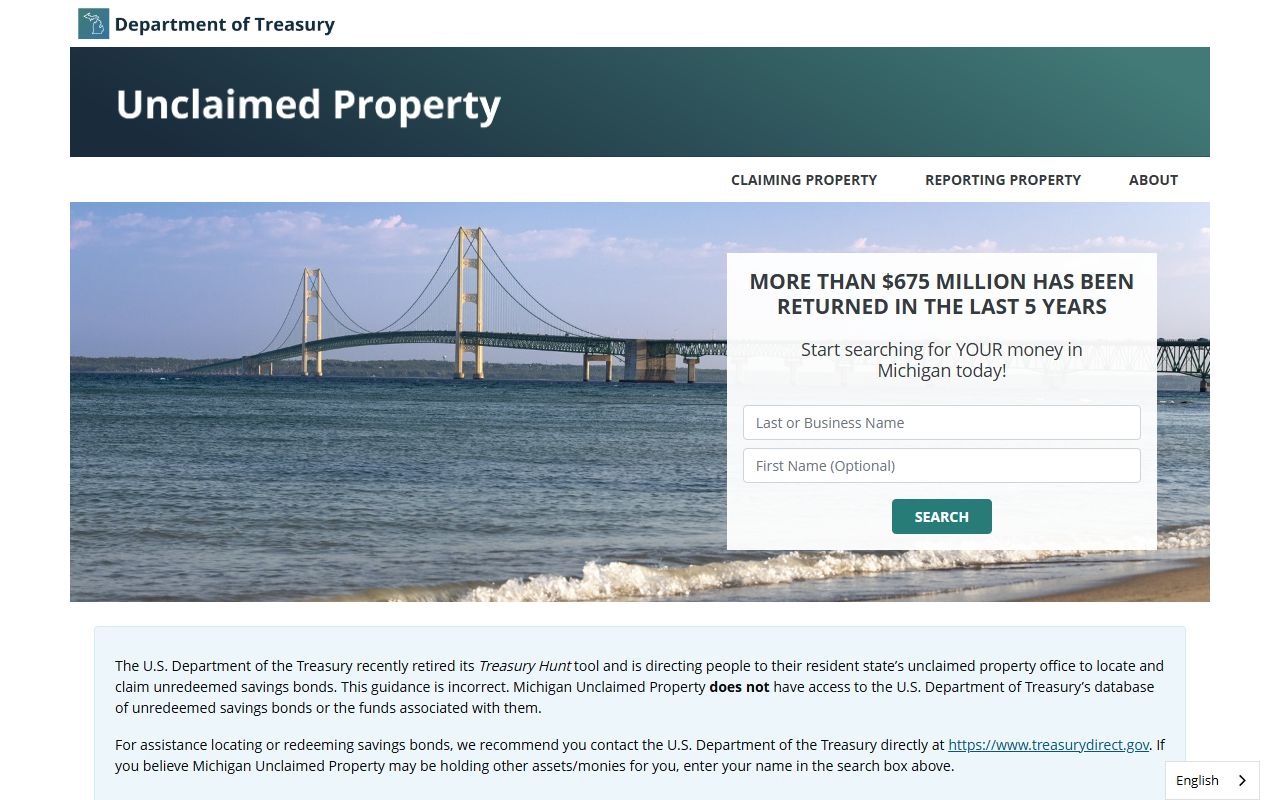
Start here. Search your name, check results carefully, and follow the claim link tied to each entry.
You can also search for deceased relatives. If a parent or grandparent had Michigan accounts, those funds may still be sitting unclaimed. The state holds them until someone files a valid claim, and there is no deadline to collect.
Kent County Treasurer
Peter MacGregor serves as Kent County Treasurer. His office sits at 300 Monroe Avenue NW in Grand Rapids (mailing address: PO Box Y, Grand Rapids, MI 49501). The Treasurer acts as custodian of all county funds, receipts and records payments, invests county assets, and collects delinquent real property taxes. The office also administers the Hotel/Motel Lodging Excise Tax.
| Treasurer | Peter MacGregor |
|---|---|
| Physical Address | 300 Monroe Avenue NW, Grand Rapids, MI 49503 |
| Mailing Address | PO Box Y, Grand Rapids, MI 49501 |
| Phone | 616-632-7500 |
| Fax | 616-632-7505 |
| Treasurer Website | kentcountymi.gov/860/Treasurer |
The Kent County main site provides access to tax information, payment portals, and the auction schedule. The Treasurer's office also manages the Delinquent Tax Revolving Fund, which allows the county to forward delinquent tax amounts directly to local units while the county pursues payment from property owners with interest and a 4% administrative fee.

The Treasurer page lists current payment options, delinquent tax search tools, and contact information for the office.

The main Kent County site links to all county departments and services, including the Treasurer, courts, and tax search tools.
Tax Foreclosure Surplus Funds
When a property sells at tax auction for more than the delinquent taxes, fees, and costs owed, the extra money is called surplus proceeds. Under Michigan law (MCL 211.78t), former owners of properties foreclosed in 2021 or later may be eligible to claim that surplus. The claim process has strict deadlines and requires action in circuit court.
Here is the basic timeline:
- The former owner files Form 5743 with the Foreclosure Government Unit (FGU) by July 1 of the year the property was sold.
- The FGU reviews the claim and responds by January 31 using Form 5744.
- If not resolved, the former owner files a motion in circuit court between February 1 and May 15.
- A court hearing is scheduled. If the claim is valid, the court orders payment.
For foreclosures that happened before 2021, the law is less clear. The Michigan Supreme Court ruled in Rafaeli v. Oakland County (2020) that taking surplus proceeds without compensating the former owner was unconstitutional. Whether that ruling applies retroactively to pre-2021 cases has been litigated in various courts. If you had a property foreclosed before 2021, speak with an attorney about whether you still have a claim.
Note: Mortgage foreclosures in Kent County are handled differently. Those foreclosure sales are listed in the Grand Rapids Legal News and are NOT conducted by the Kent County Treasurer. If your property was lost through a mortgage foreclosure rather than a tax foreclosure, you will need to look elsewhere for surplus information.
Kent County Property Auction
Kent County auctions foreclosed properties through Tax-Sale.info. The auction platform is managed by Title Check LLC. The foreclosed property list typically becomes available around July 1. Bidders can register and search listings at tax-sale.info or call 800-259-7470 for help with the process.

The auction page on the Kent County site explains the Right of First Refusal process and timeline for each annual auction cycle.

Tax-Sale.info is the platform used for the actual auction. You can search available properties, review bid requirements, and register to participate.
The Right of First Refusal gives the State of Michigan first access to foreclosed properties. After the state, local cities, villages, townships, and the county itself have the right to acquire properties before they go to public auction. Properties not claimed through the Right of First Refusal are then sold to the highest bidder.
Note: A former owner cannot purchase their own foreclosed property at auction for less than the amount of taxes owed. This rule is specific to Kent County's auction process and is stated clearly in county policy.
Michigan Tax Foreclosure Timeline
Michigan uses a three-year process before a property reaches foreclosure. Understanding where a property sits in that timeline helps you know what options remain.
Taxes not paid by March 1 of the year after they are due become delinquent. At that point a 4% administrative fee is added, plus 1% per month from the original due date. By March 1 of the second year, the property is forfeited to the county treasurer. Forfeiture does not mean the property is lost. It means the property is now being prepared for potential foreclosure. The owner still has roughly two years from that point to pay the full amount owed.
If no payment is made, the county files for foreclosure. Once the court enters a foreclosure judgment, the property cannot be reclaimed. That is the point of no return. The delinquent tax interest rate during forfeiture is 1.5% per month. Additional fees include a title search ($175 in many counties) and recording fees. These costs add up quickly, which is why acting early matters.
Legal Aid and Help Resources
If you need help understanding a tax foreclosure, filing a surplus claim, or navigating the circuit court process, several free resources are available to Kent County residents.
Michigan Legal Help provides step-by-step guides on how to ask for leftover money after a tax foreclosure at michiganlegalhelp.org. The guides are written in plain language and cover the form filing process, deadlines, and what to expect in court.
The State Bar of Michigan runs a Lawyer Referral Service at lrs.michbar.org. You can also reach them by calling (800) 968-0738. A referral connects you with an attorney who handles your type of case. An initial consultation is typically available for a low flat fee.
The Michigan Homeowner Assistance Fund (MIHAF) at michigan.gov/mihaf may have programs to help residents avoid foreclosure or catch up on delinquent taxes. Check current availability, as funding levels change over time.
Cities in Kent County
Two cities in Kent County have populations above 100,000 and have dedicated records pages.
Other cities in Kent County include Walker, Kentwood, East Grand Rapids, Grandville, and Cedar Springs. These cities do not have dedicated pages due to population thresholds, but residents in those areas can use the Kent County Treasurer's office and the state unclaimed property search for assistance.
Nearby Counties
Kent County borders several other West Michigan counties. Each has its own treasurer's office and handles tax foreclosure surplus claims independently.