
Ottawa County Unclaimed Money Lookup
Ottawa County is one of Michigan's fastest-growing counties, with over 305,000 residents along the Lake Michigan shoreline. Residents can search for unclaimed money through Michigan's free state portal and can pursue tax foreclosure surplus claims through the county treasurer's office in Grand Haven. Ottawa County was also the subject of a federal court case that helped define property owners' rights in tax foreclosure proceedings.
Ottawa County Overview
Michigan State Unclaimed Property
The Michigan Department of Treasury manages the state unclaimed property program at unclaimedproperty.michigan.gov. The search is free and open to anyone. You can look up funds by your name, a family member's name, or a business name. Michigan has returned over $675 million to residents and businesses since the program began.
Types of unclaimed property include dormant checking and savings accounts, uncashed checks, security deposits that were never returned, life insurance proceeds, and stock dividends or brokerage assets that were abandoned. Businesses must report these assets to the state after they go dormant for a set period, usually three to five years. Once the state takes custody, the funds stay available indefinitely. There is no deadline to file a claim and no fee to search.
Contact the state treasury at (517) 636-5320 or email TreasUPD@michigan.gov if you need help with a pending claim or have questions about what documentation is needed.
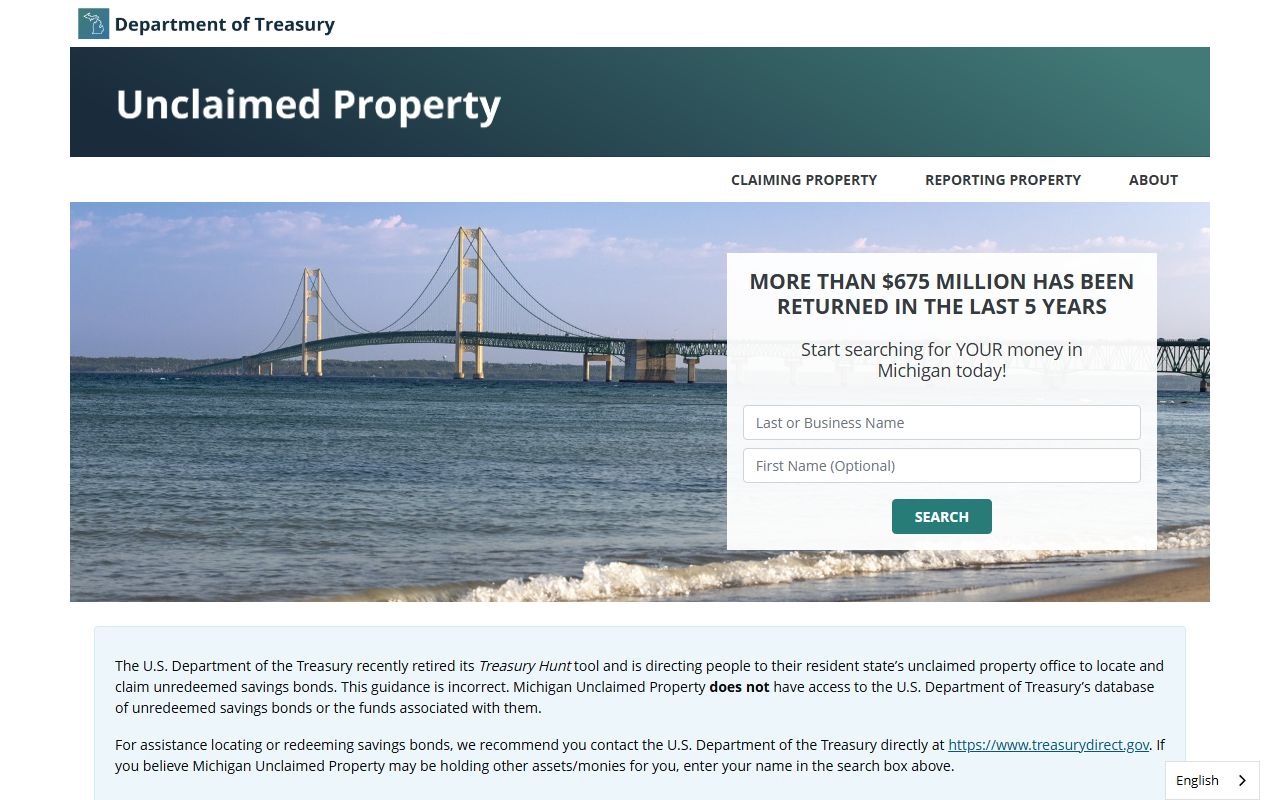
The portal above lets you search the Michigan unclaimed property database at no cost. It is the first place any Ottawa County resident should check.
Ottawa County Treasurer
The Ottawa County Treasurer's Office is located in Grand Haven, the county seat. The office handles property tax billing, delinquent tax collection, the three-year foreclosure process, and the MCL 211.78t surplus claims procedure. Current contact information, office hours, and staff listings are available at the county's official website.
Ottawa County has a growing population and active real estate market, which means the number of properties going through the foreclosure cycle each year fluctuates. If you owned a property in Ottawa County that was taken in a tax foreclosure after July 17, 2020, contact the treasurer's office to find out what the auction generated and whether a surplus exists. Have the parcel number ready when you call or write. That number helps staff pull up the specific property records quickly.
The treasurer's office also handles poverty exemption applications and can direct you to payment plan options if you are currently delinquent on taxes but have not yet reached the forfeiture stage. Getting help early is important. The fees and interest that accumulate in the second year of the process can add up fast and make it harder to catch up.
Tax Foreclosure Surplus Funds
When an Ottawa County property sells at a tax foreclosure auction for more than the total amount owed in taxes, fees, and interest, the difference is surplus funds. Under MCL 211.78t, the former property owner has the right to claim those surplus proceeds. This right applies to foreclosures that occurred on or after July 17, 2020.
Grainger v. Ottawa County: Federal Court Affirms Property Rights
Ottawa County was the defendant in Grainger v. Ottawa County, a federal case decided in the Western District of Michigan (Case No. 1:19cv00501). This case addressed whether a property owner retained rights to surplus proceeds from a tax foreclosure sale, and what legal framework governed those rights.
In that case, the court cited the Michigan Supreme Court's July 17, 2020 ruling in Rafaeli LLC v. Oakland County as controlling precedent. The Rafaeli decision established that common law recognizes the former owner's right to surplus proceeds from a forced sale. The federal court applied this reasoning to the Ottawa County facts. A property owner does not lose all rights during the foreclosure process. Forfeiture of the property does not mean the former owner loses any claim to value that exceeds the tax debt. The county treasurer does not acquire rights to any proceeds that go beyond what was owed.
Michigan Constitution Article 10, Section 2 was central to the court's analysis. That provision protects the former owner's property right to surplus proceeds as a form of private property that cannot be taken by the government without compensation. Ottawa County's experience in this federal litigation reinforced the legal framework that MCL 211.78t was later enacted to implement.
Filing a Surplus Claim in Ottawa County
The process follows the statewide MCL 211.78t framework. File Form 5743 (Notice of Intention to Claim Proceeds) with the Ottawa County Treasurer by July 1 of the year following foreclosure. The deadline is firm. Courts have rejected late filings. You must file before the auction occurs and before you know whether a surplus will result.
After the auction, the county completes Form 5744 and notifies valid claimants of the proceeds by January 31. If your Form 5743 was filed on time and a surplus exists, you then file a motion with the Ottawa County Circuit Court between February 1 and May 15. The court sets payment priorities and issues an order. The county pays within 21 days of the court's order.
Michigan Tax Foreclosure Timeline
Ottawa County follows Michigan's standard three-year foreclosure cycle. Here is how it works from the first missed payment to the auction.
Year One - Delinquency: Property taxes become delinquent on March 1 and transfer to the county treasurer for collection. A 4% administrative fee is added immediately, plus 1% per month interest. Certified mail notices go out in June and September. A $15 notification fee is added October 1.
Year Two - Forfeiture: If taxes remain unpaid on March 1, the property is forfeited to the county treasurer. A $235 minimum fee is added. The interest rate rises to 1.5% per month, applied retroactively from March 1 of the prior year. Through the rest of the year, additional fees for property visits, lienholder notices, and newspaper listings are charged. An administrative show cause hearing is scheduled, followed by a judicial foreclosure hearing if the owner does not resolve the debt.
Year Three - Foreclosure: March 31 is the final day to pay and stop the foreclosure. On April 1, title transfers to the Ottawa County Treasurer. The county schedules the property for auction. If the sale price exceeds the total debt, surplus proceeds are subject to MCL 211.78t claims.
Tax Sale Auctions in Ottawa County
Ottawa County uses Tax-Sale.info to manage and publicize its tax foreclosure auctions. Tax-Sale.info operates across 74 or more Michigan counties and is reachable at (800) 259-7470. Properties are listed on the platform ahead of each auction. Bidders can register and participate through the site.
If you are a former owner checking whether a surplus existed from a past auction, search the sale results on Tax-Sale.info using the property address or parcel number. If the listed sale price is higher than the debt you knew existed at the time of foreclosure, a surplus may have been generated. The only way to access those funds is through the MCL 211.78t process, and only if Form 5743 was filed in time.
Legal Aid Resources
Ottawa County residents have access to several resources for help with surplus claims and foreclosure-related questions.
Michigan Legal Help at michiganlegalhelp.org walks through the entire surplus claim process step by step. It covers Form 5743, Form 5744, and the circuit court filing window. The guides are free and written in plain language.
State Bar of Michigan Lawyer Referral Service at (800) 968-0738 or lrs.michbar.org can connect you with an Ottawa County attorney familiar with property tax and foreclosure matters.
Michigan Homeowner Assistance Fund (MIHAF) at michigan.gov/mihaf offers financial support for homeowners behind on property taxes due to COVID-related hardship. Check the eligibility criteria before applying.
West Michigan Legal Services also serves Ottawa County residents who meet income eligibility requirements. They can advise on foreclosure prevention and surplus recovery depending on where you are in the process.
Cities in Ottawa County
No cities in Ottawa County currently meet the population threshold for a dedicated city page on this site. Holland is the largest city in the county but falls below the threshold. For unclaimed money searches related to any city in Ottawa County, use the state portal at unclaimedproperty.michigan.gov and contact the Ottawa County Treasurer's Office for questions about tax foreclosure surplus funds.
Nearby Counties
Ottawa County shares borders with several counties in western Michigan. Each follows the same MCL 211.78t process for surplus claims and has its own treasurer's office.