
Find Unclaimed Money in Clare County
Clare County residents have two key ways to find unclaimed money: searching the Michigan Department of Treasury's statewide database and checking whether tax foreclosure surplus funds are owed from a past property sale. Michigan holds more than $675 million in unclaimed property right now, and Clare County property owners who lost land to tax foreclosure since 2021 may be owed money under MCL 211.78t. Treasurer Jenny Beemer-Fritzinger's office in Harrison handles delinquent taxes and foreclosure surplus matters for the county, and this page covers everything you need to know about both programs.
Clare County Overview
Michigan State Unclaimed Property Search
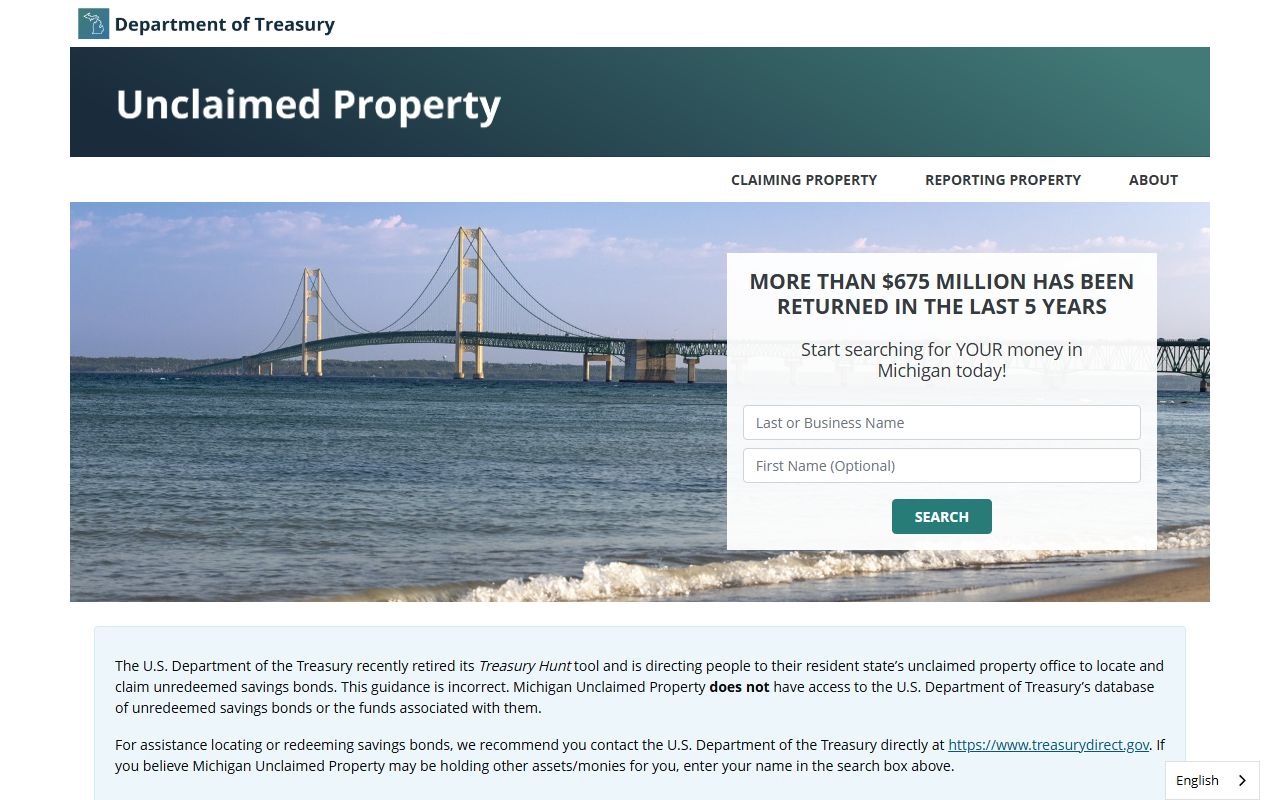
Search the Michigan Treasury's free database at unclaimedproperty.michigan.gov. No login is needed. Just enter your name and see what comes up. The database covers all types of unclaimed financial property reported to the state by banks, insurers, employers, and other companies.
Common sources of unclaimed funds include dormant bank accounts, uncashed payroll or tax refund checks, insurance policy proceeds, stock dividends, utility deposit refunds, and safe deposit box contents. Under Michigan law, companies must turn these over to the state after a set dormancy period, usually one to three years. The state holds the money indefinitely. There is no deadline to claim what's yours.
To file a claim, prepare a government-issued ID and documentation tying you to the property. That might be an old bank statement, a W-2, or a utility bill from the address on file. Larger claims often require notarized paperwork. Processing generally takes 60 to 90 days once a complete claim is received.
For claim status or questions: call (517) 636-5320 or email TreasUPD@michigan.gov.
The Michigan Unclaimed Property portal is where Clare County residents should start their search.
Search periodically. New accounts are reported to the state every year, so a search that turns up nothing today may produce results later.
Clare County Treasurer
Clare County Treasurer Jenny Beemer-Fritzinger manages the county's delinquent tax accounts and tax foreclosure process. Contact details:
Address: 225 West Main Street, P.O. Box 564, Harrison, MI 48625
Phone: (989) 539-7801
Fax: (989) 539-0866
Email: beemer-fritzingerj@clareco.net
Office hours: Monday through Friday, 8:00 AM to 4:30 PM
The office offers online access to property tax and assessment records, including delinquent tax status (shown in a pink box on the property search results). You can also pay delinquent taxes online for 2024 and prior years.
One important note about mail payments: effective December 24, 2025, the USPS no longer postmarks mail at local branch offices. Mail is now postmarked at regional processing facilities, which can add a day or more. The Treasurer's office strongly recommends sending any tax payments well before the deadline or asking a postal clerk to manually stamp your envelope at the counter. A late postmark can result in additional fees and penalties even if you sent the payment on time.
Property search results include owner name, assessment info, property class, PRE status, school district, legal description, sale history, building information, and current delinquent tax status. If the property has delinquent taxes, they'll appear in the pink box in the search results.
The Clare County Treasurer page at clareco.net has the latest information on payment options and office procedures.
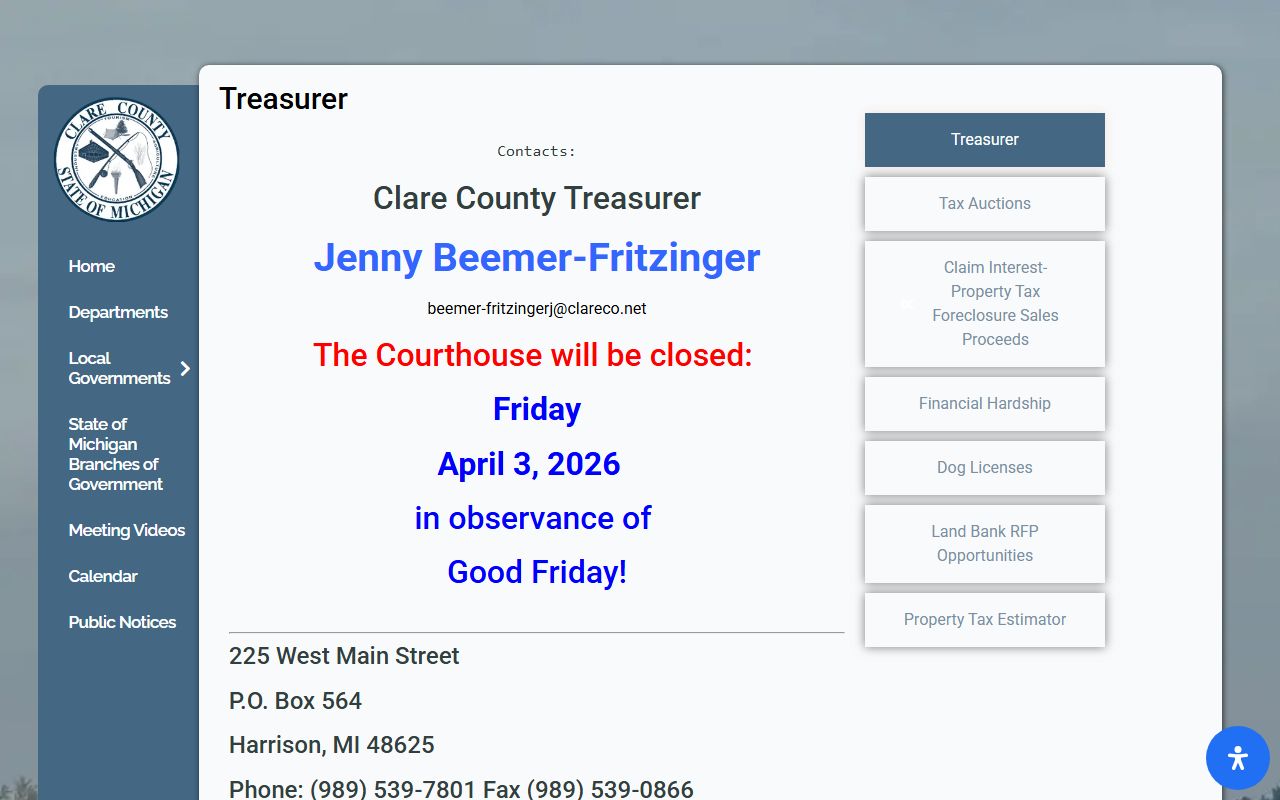
Check this page for any updated hours, payment system changes, or announcements about tax auction schedules.
Tax Foreclosure Surplus Funds in Clare County
When Clare County forecloses on a property for unpaid taxes and the auction sale price exceeds what was owed, the leftover money is called a surplus. That surplus belongs to you, not the county. Michigan law under MCL 211.78t requires that surplus funds be returned to the former owner or other parties with a legal interest in the property, such as a mortgage lender.
The 2020 Michigan Supreme Court case Rafaeli v. Oakland County was the turning point. The court ruled that counties violated property owners' constitutional rights by keeping surplus proceeds. Former owners now have a clear legal path to claim that money.
Clare County runs tax auctions online only through tax-sale.info. The 2025 Reverted Public Land Auction has concluded; for information about the next auction, contact the Treasurer's office around July 1. Published auction results and foreclosure notices appear in official county records.
Clare County is included in class action litigation under Docket No. 349636, which also includes Roscommon, Montmorency, Alpena, Oscoda, Alcona, Arenac, Ogemaw, and Gladwin counties. If your property was foreclosed before 2021, you may have rights under that class action. Consult a lawyer to assess your situation.
For properties foreclosed in 2021 and later, the MCL 211.78t process works as follows:
File Form 5743 by July 1. Submit the Claim for Excess Proceeds to the circuit court by July 1 of the year following the foreclosure sale. This is how you assert your legal right to any surplus funds.
Receive the accounting notice by January 31. The county treasurer sends you a written statement showing sale proceeds, deductions, and the net surplus amount owed to you.
File CC540 between February 1 and May 15. If you need to pursue your claim in court, file the CC540 motion during this window. Missing the May 15 deadline can eliminate your right to those funds.
A hardship extension can delay foreclosure by one full year. To get one, you must bring a completed hardship application to the Show Cause Hearing. Interest and fees continue to accrue during the extension period, so this is not a free option. But it can give you time to get finances in order or sell the property.
Michigan Tax Foreclosure Timeline
Understanding the three-year Michigan foreclosure timeline helps you know where your property stands and what actions are still available.
Year 1: Delinquency. Taxes go unpaid. On March 1 of the next calendar year, the county treasurer takes over collection from the local township or city. A 4% administrative fee is immediately added to the unpaid balance. Monthly interest at 1% starts accruing. Every month of delay increases what you owe.
Year 2: Forfeiture. On March 1 of the second year, the property is forfeited to the county treasurer. You still own the property. You can still pay and keep it. But the interest rate jumps to 1.5% per month, calculated retroactively from the original delinquency date. The total owed can increase significantly in a short time after forfeiture.
Year 3: Foreclosure. On April 1 of year three, the circuit court enters a foreclosure judgment. The right to redeem the property by paying back taxes is gone for most owners. The property is transferred to the county land bank or sold at public auction through tax-sale.info.
If you're anywhere in this process, contact Treasurer Beemer-Fritzinger at (989) 539-7801 right away. Payment plans may be available. The hardship extension described above can delay foreclosure. But neither option helps if you wait until after the foreclosure judgment is entered.
Legal Aid Resources for Clare County
Legal Services of Eastern Michigan serves Clare County. Office: 301 E. Genesee Avenue, 5th Floor, Saginaw, MI 48607. Toll-free phone: 1-800-322-4512. Phone intake hours: Monday through Wednesday 9:30 AM to 12:30 PM and 1:30 PM to 3:30 PM; Thursday 9:30 AM to 12:30 PM. They handle housing, tax, and other civil legal matters for income-eligible residents.
Michigan Legal Help at michiganlegalhelp.org offers free guides on tax foreclosure rights, surplus fund claims, and unclaimed property searches. Written for non-lawyers, the guides walk through forms and deadlines step by step.
State Bar of Michigan Lawyer Referral Service: Call (800) 968-0738 or visit lrs.michbar.org to be matched with a real estate or tax attorney in your area. There is a small fee for the initial consultation referral.
Michigan Homeowner Assistance Fund (MIHAF) offers up to $25,000 for eligible homeowners with delinquent property taxes or other housing-related debts. Visit michigan.gov/mihaf for current eligibility requirements and to apply online. Funding is limited.
Cities in Clare County
No cities in Clare County meet the 100,000-population threshold for a dedicated city page. Harrison is the county seat. Residents of Harrison, Clare, Farwell, and other Clare County communities should use the Michigan unclaimed property portal at unclaimedproperty.michigan.gov and contact the Treasurer's office at (989) 539-7801 for foreclosure surplus questions.