
Find Unclaimed Money in Sanilac County
Sanilac County is in Michigan's Thumb region, bounded by Lake Huron to the east and bordered by Huron, Tuscola, Lapeer, and St. Clair counties. Two programs hold unclaimed money for Sanilac County residents: the Michigan Department of Treasury's unclaimed property database, which collects dormant bank accounts, uncashed checks, insurance proceeds, and similar financial assets, and the county's tax foreclosure surplus process, which returns leftover auction proceeds to former property owners under MCL 211.78t. Both are free to search and free to claim. This page explains how to find and recover what is yours.
Sanilac County Overview
Michigan State Unclaimed Property Search
The Michigan Department of Treasury collects financial assets that have gone dormant and whose owners could not be located by the holding business. Banks, insurance companies, utility providers, and other businesses are required to turn these assets over to the state after a set period, usually three to five years of no contact. The state holds the funds without a time limit, meaning you can file a claim years or even decades after the money was reported.
Michigan's unclaimed property database is free to search at unclaimedproperty.michigan.gov.
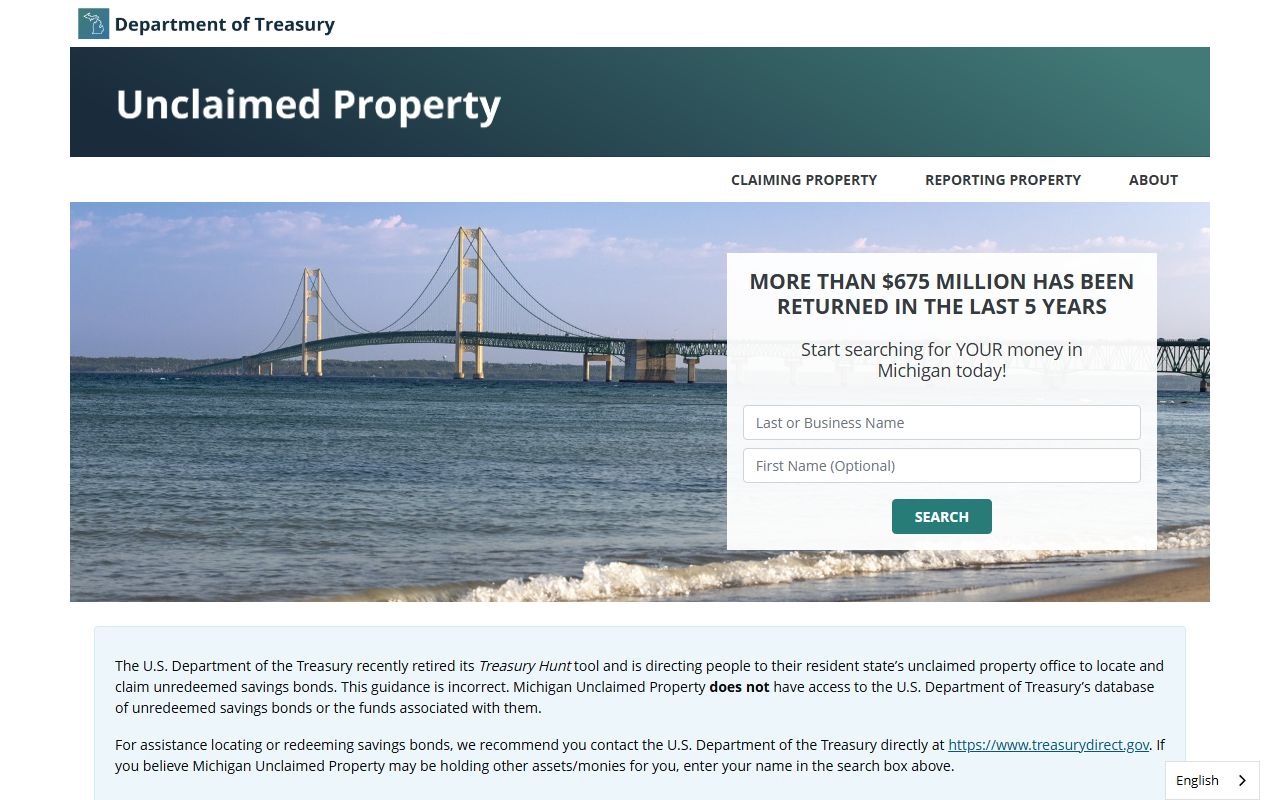
The state has returned over $675 million in the last five years. Search by name at no cost.
Search by name on the state site. You can look up former addresses, maiden names, or deceased relatives. When a match comes up, click through to begin the claim. Most claims ask for a government ID and some proof of your connection to the account. The Treasury typically processes claims in 90 to 120 days. Questions can go to (517) 636-5320 or TreasUPD@michigan.gov. There is no fee at any point.
If you have moved out of the Thumb area or lived in other Michigan cities, search those old addresses too. Unclaimed funds are linked to the last known address on file, so past residences are worth checking.
Sanilac County Treasurer
The Sanilac County Treasurer is responsible for managing county funds, collecting delinquent property taxes, and administering the tax foreclosure process when property owners fall too far behind. After a foreclosure, if the property sells at auction for more than the taxes and fees owed, the surplus must be returned to the former owner under state law.
| County Seat | Sandusky, MI |
|---|---|
| Region | Thumb region, eastern Michigan |
| Service Area | All townships and communities in Sanilac County |
| County Website | sanilaccounty.net |
The treasurer's office handles tax liens, delinquent tax collection, the forfeiture and foreclosure process, and certification of tax histories on deeds. Contact the Sanilac County Treasurer's office directly to confirm current contact details, office hours, and the status of any delinquent tax account.
For property tax lookup and delinquent tax information, the county website is the best starting point. Look under the treasurer or equalization sections.
Tax Foreclosure Surplus Funds in Sanilac County
Michigan's 2020 Supreme Court ruling in Rafaeli, LLC v. Oakland County changed how surplus funds from tax foreclosure sales are handled. The court ruled that the government cannot keep more than what was owed. Any proceeds above the debt must go back to the former owner. The state legislature then passed MCL 211.78t to set up a formal claim process for foreclosures in 2021 and later.
Sanilac County follows the standard MCL 211.78t procedures. If your property was foreclosed and sold at auction for more than you owed in taxes, fees, and costs, you may be entitled to that surplus.
How to File a Surplus Claim
Two forms are required, and each has a strict deadline.
- Form 5743 - Notice of Intent to Claim Interest in Foreclosure Sale Proceeds. File this with the Sanilac County Treasurer by July 1 in the year following your property's foreclosure. Filing this form puts the county on notice that you intend to pursue the surplus.
- Form 5744 - Petition to Claim Interest in Foreclosure Sale Proceeds. File this with the county circuit court by January 31 of the year after you filed Form 5743.
- Circuit court hearings on surplus claims are scheduled between February 1 and May 15. If your claim is valid, the court issues an order directing the county to pay.
Both forms are available through the Michigan Department of Treasury website. If your property was foreclosed and sold between 2013 and 2020, different rules may apply. A Class Action Settlement process was set up for sales in that window. Talk to a legal aid attorney or check with the county treasurer to find out which process applies to your situation.
Michigan Tax Foreclosure Timeline
Michigan law requires a three-year process before a property can be foreclosed for unpaid taxes. Here is how it works:
- Year 1: Taxes become delinquent on March 1. The county places a lien on the property.
- Year 2: The property is forfeited to the county on March 1. The owner still has time to pay, but interest and fees are significantly higher at this stage.
- Year 3: Foreclosure is final on March 31. The county takes title and can auction the property, typically in the summer or fall.
Owners who receive forfeiture or foreclosure notices should act right away. Missing the redemption deadline means losing the property. Even after that point, the surplus claim process can recover funds if the auction price exceeded what was owed.
Legal Aid and Housing Resources in Sanilac County
Sanilac County residents who need help with a surplus fund claim or tax foreclosure issue can get free assistance through Legal Services of Eastern Michigan. The Saginaw office covers Sanilac County. The address is 301 E. Genesee Avenue, 5th Floor, Saginaw, MI 48607. The toll-free number is 1-800-322-4512. Income eligibility limits apply, but staff can confirm whether you qualify and what help is available.
Michigan Legal Help at michiganlegalhelp.org has free guides on the surplus fund claim process, instructions for filling out Forms 5743 and 5744, and information on what to expect at a circuit court hearing. The site is free and does not require an account.
The State Bar of Michigan Lawyer Referral Service connects you with a local attorney for a low-cost consultation. Call (800) 968-0738 or go to lrs.michbar.org.
The Michigan Homeowner Assistance Fund (MIHAF) provides grants up to $25,000 for homeowners who fell behind on taxes or housing costs due to COVID-19 hardship after January 21, 2020. Eligibility requires owning and occupying the home as a primary residence and having household income below 150% of the Area Median Income. MIHAF can cover property taxes, mortgage payments, utilities, and other housing expenses. Apply at michigan.gov/mihaf.
Other Sources of Unclaimed Money
State unclaimed property and tax foreclosure surpluses are not the only places to look. Sanilac County residents may also have unclaimed funds from federal sources. The IRS holds undelivered tax refunds that can be claimed at irs.gov. The Department of Labor maintains a database of abandoned pension plans at dol.gov. Veterans may have unclaimed VA insurance proceeds through the VA's website.
Class action settlements are worth checking. Many large settlements pay small amounts to a large number of people, but those payments go unclaimed when the recipient has moved or does not know about the case. A search for your name in national settlement databases can turn up payments you did not know you were owed.
Sandusky is the county seat of Sanilac County but does not currently meet the population threshold for a dedicated city page. Residents of Sandusky and all other communities in Sanilac County can use the same state and county resources described on this page.
Cities in Sanilac County
Sandusky is the county seat and largest community in Sanilac County. No cities in Sanilac County currently meet the population threshold for a dedicated city page. All county residents can use the state unclaimed property database and the county surplus fund process to search for and claim any money owed to them.