
Search Oscoda County Unclaimed Money
Oscoda County residents may have unclaimed funds held by the Michigan Treasury or surplus proceeds from a past tax foreclosure sale. This page covers the state unclaimed property search, how to reach the Oscoda County Treasurer in Mio, the surplus claim process under MCL 211.78t, and where to find legal help if you have questions about your rights as a former property owner.
Oscoda County Overview
Michigan State Unclaimed Property Search
Search Michigan's free statewide unclaimed property database at unclaimedproperty.michigan.gov.
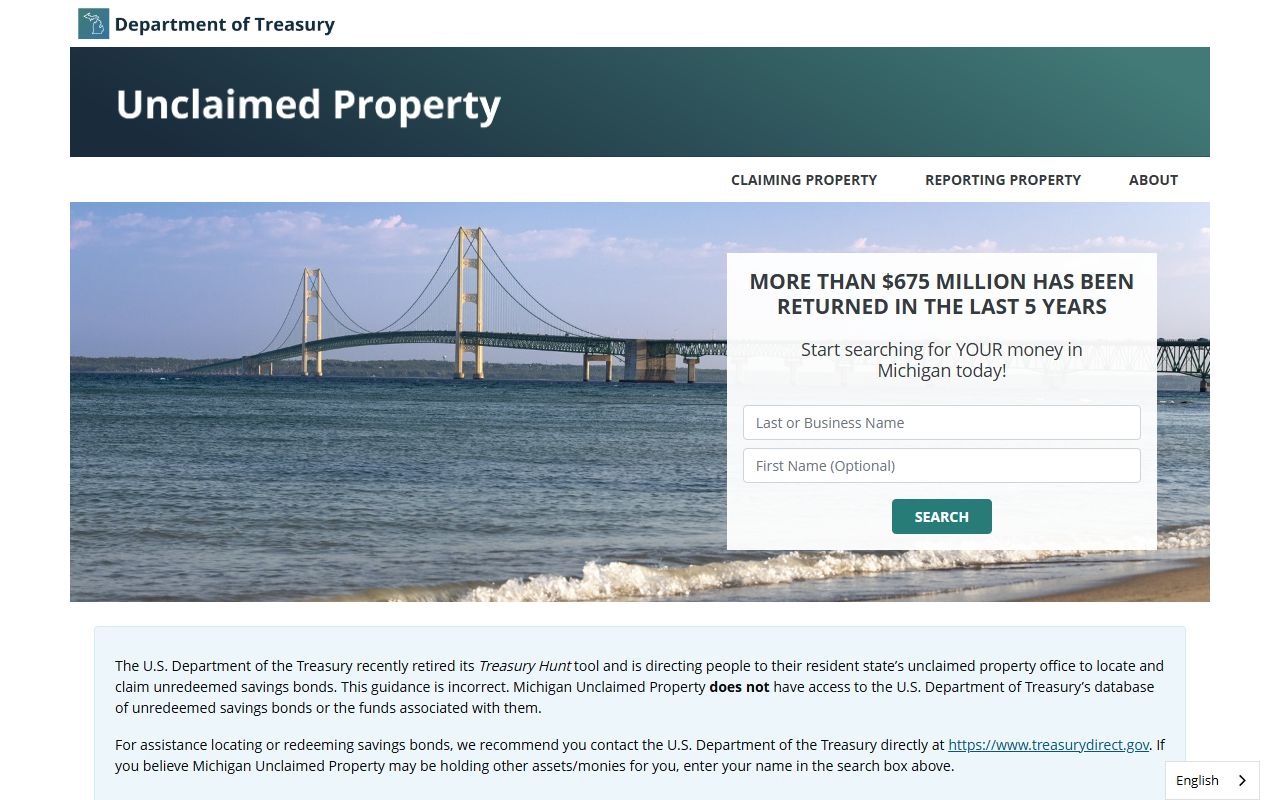
The database holds $675 million in unclaimed funds. Search is free and takes only a few minutes.
The Michigan Department of Treasury collects dormant financial accounts, uncashed checks, insurance proceeds, utility deposits, and other property from businesses that cannot locate the rightful owners. Once these funds reach the state, they are held indefinitely. You can search and file a claim at any time, no matter how long ago the funds were turned over.
To search, visit the site and enter a name or business name. If a match appears, you can start a claim right online or download the claim form to submit by mail. Most approved claims are paid within 90 days. For questions, call the Michigan Treasury at (517) 636-5320 or email TreasUPD@michigan.gov.
Oscoda County Treasurer
The Oscoda County Treasurer's office in Mio handles delinquent property tax collection for the county. If you have questions about delinquent taxes, a past foreclosure, or a possible surplus from a tax sale, contact the treasurer directly.
| Office | Oscoda County Treasurer |
|---|---|
| Address | 311 Morenci Ave., Mio, MI 48647 |
| County Seat | Mio, Michigan |
| County Code | 68 |
| Circuit Court | 23rd Circuit Court (Alcona, Arenac, Iosco, and Oscoda Counties) |
Oscoda County is served by the 23rd Circuit Court, which covers Alcona, Arenac, Iosco, and Oscoda Counties together. Foreclosure petitions, Show Cause hearings, and surplus distribution petitions for Oscoda County are all handled through this court. The court's location and contact information can be found on the Michigan Courts website at courts.michigan.gov.
Tax Foreclosure Surplus Funds in Oscoda County
When a tax-foreclosed property in Oscoda County sells at auction for more than the outstanding tax debt and costs, the remaining money is surplus. Michigan law gives the former owner and other qualifying parties the right to claim those surplus proceeds under MCL 211.78t.
This right was confirmed by the Michigan Supreme Court in Rafaeli v. Oakland County (2020). The court held that Michigan's Constitution protects a former property owner's right to the equity in their property even after a tax foreclosure. The legislature responded by creating the formal surplus claim process in MCL 211.78t.
Oscoda County is included in class action Docket No. 349636, which also covers Roscommon, Montmorency, Alpena, Alcona, Arenac, Ogemaw, Clare, and Gladwin Counties. This litigation dealt with how surplus funds were managed by these counties following the Rafaeli ruling.
Key Deadlines and Forms
| Form 5743 | Notice of Intent to Claim Interest in Foreclosure Surplus - due July 1 in the foreclosure year |
|---|---|
| Form 5744 | Claim for Foreclosure Surplus Proceeds - due January 31 in the year after foreclosure |
| Form CC540 | Circuit Court petition for surplus - filed February 1 through May 15 at the 23rd Circuit Court |
| Statute | MCL 211.78t - the exclusive mechanism for claiming surplus proceeds in Michigan |
Courts have held that MCL 211.78t is the only way to pursue surplus claims. You cannot use other legal theories to claim the same money outside this process. If you miss the filing deadlines, you lose your right to the surplus. Act quickly and keep track of the calendar.
Michigan Tax Foreclosure Timeline
Michigan uses a structured three-year process from delinquency to foreclosure. Here is how it works in Oscoda County.
| Year 1 - Delinquency | Taxes not paid to township; county treasurer takes over account on March 1; fees and interest begin |
|---|---|
| Year 2 - Forfeiture | Property forfeited on March 1; forfeiture certificate recorded; owner can still pay and redeem the property |
| Year 3 - Foreclosure | County files petition in 23rd Circuit Court; Show Cause hearing scheduled; judgment entered if taxes remain unpaid; title vests in county March 31 |
| After Sale | County sells at auction; surplus above tax debt available to claim under MCL 211.78t |
It is worth repeating: forfeiture and foreclosure are different. A forfeited property can still be redeemed. Once a circuit court enters a foreclosure judgment, redemption is no longer possible. If you receive a forfeiture notice, the clock is ticking but you still have options. Contact the treasurer's office or a legal aid organization right away.
Other Sources of Unclaimed Money
Beyond the state Treasury database and tax foreclosure surplus, there are other places worth checking for unclaimed money.
The 23rd Circuit Court, which serves Oscoda County, may hold unclaimed funds from civil judgments and other court proceedings. If you were awarded money in a lawsuit that was never collected, or if you were a creditor in a case, there may be funds on deposit with the court. Contact the circuit court clerk for details.
The Pension Benefit Guaranty Corporation holds retirement benefits from terminated private-sector pension plans. If a former employer shut down its defined benefit plan, the PBGC may be holding your pension. Search pbgc.gov for free.
Federal bankruptcy courts also hold unclaimed funds from cases where creditors could not be found. If you were a creditor in a federal bankruptcy filed in the Eastern or Western District of Michigan, the court may hold your share of distributions. The PACER system provides access to federal court records.
Veterans' benefits sometimes go unclaimed. The Michigan Veterans Affairs Agency can help identify benefits that were never collected. Reach them at 1-800-MICH-VET.
Legal Aid and Help for Oscoda County Residents
Several free and low-cost resources are available to Oscoda County residents who need help with unclaimed property or tax foreclosure issues.
| Michigan Legal Help | michiganlegalhelp.org - free guides, including a step-by-step guide on claiming foreclosure surplus funds |
|---|---|
| Lawyer Referral | lrs.michbar.org - State Bar of Michigan referral line: (800) 968-0738 |
| Michigan HAF | michigan.gov/mihaf - Homeowner Assistance Fund for mortgage, tax, and utility help |
Michigan Legal Help's guide on claiming leftover money after a tax foreclosure is particularly useful for Oscoda County residents. It explains Forms 5743 and 5744 in plain language and walks through what to expect at a circuit court hearing. Start there before calling an attorney, so you know what questions to ask.
If you are at risk of foreclosure and want to avoid it, the Michigan Homeowner Assistance Fund may be able to help with delinquent property taxes. Check eligibility at michigan.gov/mihaf.
Cities in Oscoda County
Oscoda County is a small, rural county with no incorporated cities that meet the 100,000-population threshold for a dedicated city page on this site. The county seat is the village of Mio. All Oscoda County residents can use the resources on this page to search for unclaimed money or pursue a surplus claim.