
Luce County Unclaimed Money
Luce County residents can search for unclaimed money through Michigan's free state database, which holds dormant bank accounts, forgotten insurance proceeds, and other abandoned assets from across the state. This Upper Peninsula county follows Michigan's standard tax foreclosure procedures under MCL 211.78, and former property owners with qualifying foreclosures may have surplus funds available to claim.
Luce County Overview
Michigan State Unclaimed Property Search
The Michigan Department of Treasury holds unclaimed assets in a free searchable database at unclaimedproperty.michigan.gov. The database includes dormant bank accounts, forgotten savings bonds, insurance payouts, utility refunds, uncashed checks, and other abandoned financial property. Anyone can search by name at no cost, and the state has returned more than $675 million to residents over the years.
To reach the unclaimed property division, call (517) 636-5320 or email TreasUPD@michigan.gov. Staff can confirm whether a search result is yours and help you understand what documentation to gather. Claims are free to file.
Michigan's free statewide unclaimed property search is available at unclaimedproperty.michigan.gov.
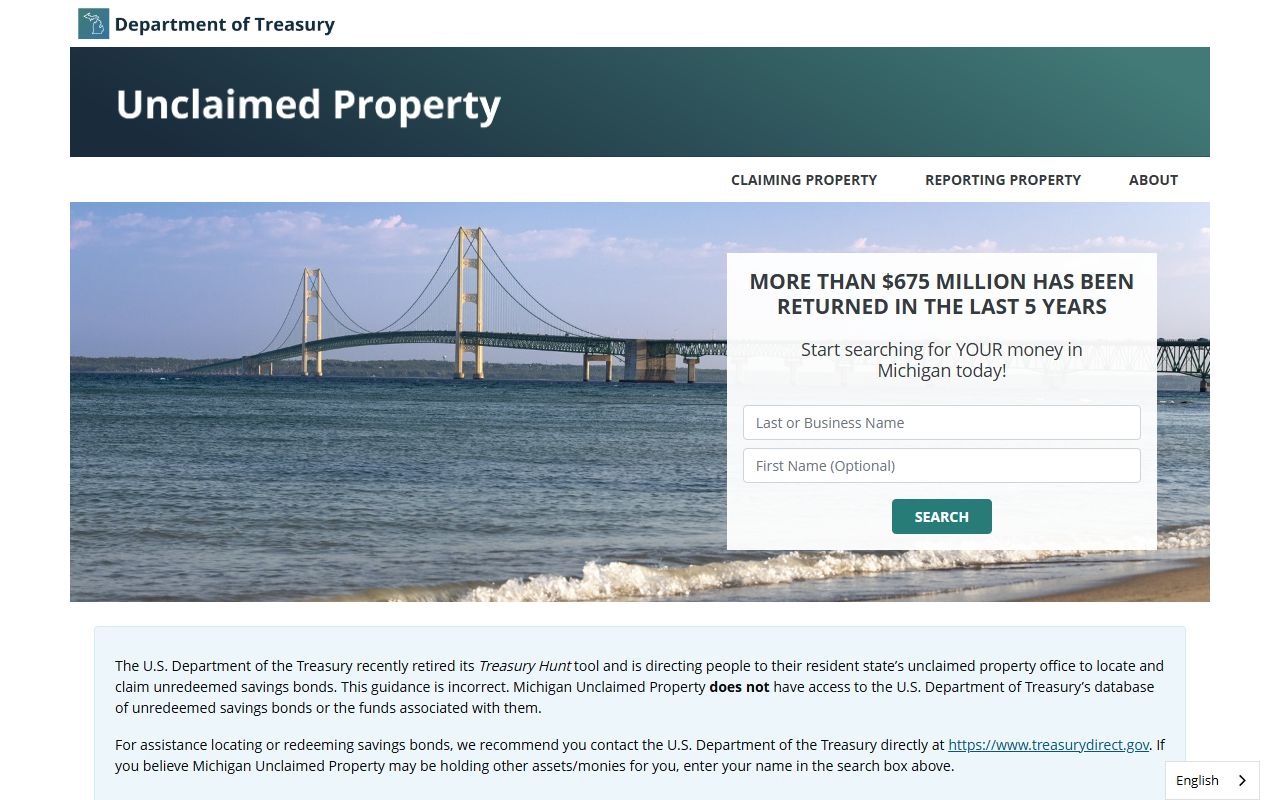
Search by name at no cost. No account required.
You can also search for deceased relatives. If a parent or grandparent held Michigan accounts, those funds may still be in the state system. There is no deadline to claim once the state holds the money.
Luce County Government
Luce County is a sparsely populated Upper Peninsula county with Newberry as its county seat. The county follows all Michigan Department of Treasury guidelines for property tax collection, delinquent tax proceedings, and foreclosure. For specific account questions or to reach the Treasurer's office, contact the county directly in Newberry.
Because Luce County is a small rural county, staffing may be limited and office hours may vary. Calling ahead before visiting in person is a good idea. The Michigan Department of Treasury at (517) 636-5320 can also answer general questions about the foreclosure process and how surplus claims work, which may be faster than waiting to reach the local office.
Luce County holds county code 48 in Michigan's unclaimed property records system. If you are researching records by county code, this number corresponds to Luce County.
Note: If you cannot reach the Luce County Treasurer by phone, try contacting the Michigan Department of Treasury directly. They can often answer general questions about foreclosure timelines, surplus claims, and form requirements without needing to go through the local office.
Tax Foreclosure Surplus Claims
Michigan law under MCL 211.78t gives former property owners the right to claim surplus funds from tax foreclosure sales that happened in 2021 or later. Surplus means the auction sale price exceeded the total amount owed in taxes, interest, and fees at the time of foreclosure.
The claim steps are:
- File Form 5743 with the county's Foreclosure Government Unit (FGU) by July 1 of the sale year.
- The FGU responds with Form 5744 by January 31 of the following year.
- If the claim is not resolved, file a motion in the Luce County Circuit Court between February 1 and May 15.
- A judge schedules a hearing. If the claim is valid, the court orders payment.
The July 1 deadline for Form 5743 is firm. Missing it forfeits your right to the surplus under this process. If your deadline is close, file the form immediately even if you are still collecting other supporting documents.
For foreclosures before 2021, the Rafaeli v. Oakland County (2020) Michigan Supreme Court ruling may provide a basis for a claim. That ruling held that counties could not retain surplus proceeds without compensating former owners. Whether the ruling helps your specific case depends on the timing and circumstances. An attorney or legal aid organization can evaluate your situation.
Michigan Tax Foreclosure Process
Michigan runs a three-year process before any property is formally foreclosed. Each stage has its own interest rates and fees, and the owner retains the right to pay and save the property at every stage until the final court judgment.
The process starts with delinquency. Unpaid real property taxes become delinquent on March 1 of the year after they are due. A 4% administrative fee is added immediately. Interest runs at 1% per month from the original due date. The county treasurer takes over collection from the local township or city.
If the balance is still unpaid by March 1 of the second year, the property enters forfeiture. Interest jumps to 1.5% per month during this period. A title search fee and recording fees are added as well. Despite the name, forfeiture does not mean the property is gone. It means the county has been formally notified and the clock is running toward possible foreclosure. The owner still has time to pay in full and keep the property.
If no payment is made, the county files for foreclosure in circuit court. A judgment of foreclosure ends the owner's rights permanently. The county takes title and schedules the property for auction. Any amount the auction brings in above the owed taxes and fees becomes surplus, which is available to the former owner under MCL 211.78t for 2021 and later foreclosures.
Property Auction Information
Foreclosed properties in Luce County are auctioned following Michigan's standard process. Many counties across the state use Tax-Sale.info to list and manage property auctions. You can search available properties and register to bid at tax-sale.info, or call 800-259-7470 for help. Foreclosed property lists are generally posted around July 1 ahead of summer auction dates.
Michigan's Right of First Refusal rules apply to all counties. The State of Michigan gets first access to any property. Local units of government, including townships, go next. Only properties not taken through the Right of First Refusal process go to public auction. In a small county like Luce, the number of properties that reach public auction in any given year may be small.
Help Resources for Luce County Residents
Free and low-cost legal help is available for Luce County residents dealing with unclaimed money, surplus claims, or tax foreclosure issues.
Michigan Legal Help provides step-by-step guides at michiganlegalhelp.org on how to claim money left over after a tax foreclosure. The guide covers Form 5743, the FGU process, and the circuit court hearing.
Legal Services of Eastern Michigan (LSEM) serves Upper Peninsula residents at (800) 322-4512 or lsem-mi.org. Free civil legal help is available to qualifying individuals, including for tax foreclosure and surplus fund claims.
The State Bar of Michigan Lawyer Referral Service is available at (800) 968-0738 or lrs.michbar.org. A referral connects you with an attorney familiar with your type of case at a low initial consultation rate.
The Michigan Homeowner Assistance Fund (MIHAF) at michigan.gov/mihaf may have programs to help homeowners catch up on delinquent taxes and avoid losing their home. Check the site for current program status.
Cities in Luce County
Luce County has no cities with populations above 100,000. Newberry is the county seat and main community. All residents use the same county-level offices for property tax and foreclosure matters.
Nearby Counties
Luce County is in the central Upper Peninsula and borders several other UP counties. Each follows the same Michigan foreclosure laws and maintains its own treasurer's office.