
Search Chippewa County Unclaimed Money
Chippewa County residents in Michigan's Upper Peninsula can search for unclaimed money through two channels: the Michigan Department of Treasury's statewide unclaimed property database and the county's tax foreclosure surplus fund process. The state holds more than $675 million in unclaimed funds for Michigan residents and businesses, and some of that money belongs to people in the Sault Ste. Marie area who never knew a claim existed. The Chippewa County Treasurer's office at 319 Court Street handles delinquent taxes and foreclosure surplus matters, and this page gives you the contact details and steps you need to check both systems.
Chippewa County Overview
Michigan State Unclaimed Property Search
The Michigan Department of Treasury maintains the state's unclaimed property database at unclaimedproperty.michigan.gov. Searching is free and open to anyone. You don't need to register or log in. Enter your name, scan the results, and see if anything belongs to you.
Property ends up in this database when companies lose track of account holders. Banks, insurance companies, employers, and utility providers are all required by Michigan law to turn over dormant accounts after one to three years. The types of unclaimed property that show up most often include checking and savings accounts, uncashed payroll or dividend checks, insurance policy proceeds, safe deposit box contents, and refunds from utility companies or government agencies.
When you find a match and want to claim it, you'll need to prove both your identity and your connection to the property. The Treasury typically asks for a government-issued photo ID plus a document linking you to the original account or address, such as an old bank statement, W-2, or utility bill. Larger claims may require notarized documentation. Standard processing time is 60 to 90 days from the date your complete claim is received.
Questions about a specific claim? Call (517) 636-5320 or email TreasUPD@michigan.gov. Treasury staff can confirm what documents you need and check the status of a claim you've already filed.
The statewide search portal is shown below. This is where all Chippewa County residents should start their search for unclaimed Michigan funds. Visit the Michigan Unclaimed Property site to begin.
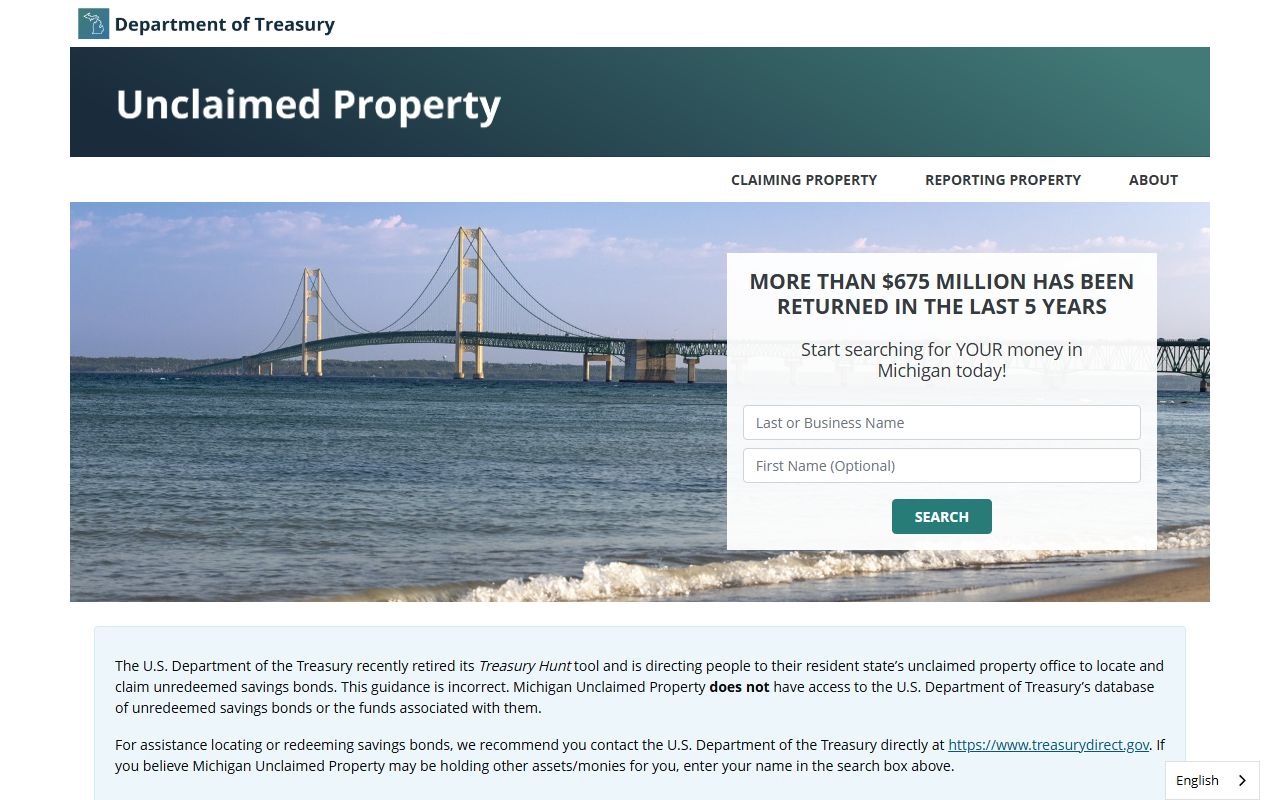
New accounts are added to the database on a rolling basis, so if you don't find anything today, it's worth checking again in six months.
Chippewa County Treasurer
The Chippewa County Treasurer is Jenni Pace. The office is at 319 Court Street, Sault Ste. Marie, MI 49783. Phone: (906) 635-6308. Office hours are Monday through Friday, 8:00 AM to 5:00 PM, except on holidays.
One important note: the Chippewa County Treasurer's office handles all tax information by phone only. Do not send questions about your tax account or delinquency status by email. Call the office directly at (906) 635-6308 during business hours to get accurate information about your account.
Delinquent tax records for Chippewa County are available online at no charge. If you want to check whether taxes on a specific property are delinquent, you can look that up without calling the office. Payment for delinquent taxes can be made through GovPay, which charges a 3% fee on credit card payments (minimum $3.99) and a flat $3.95 fee on debit card payments. In-person payment at the Treasurer's office is also available during business hours.
A GIS map covering the Eastern Upper Peninsula, including both Chippewa and Mackinac counties, is available online for viewing parcel information.
The Chippewa County Treasurer's page, accessed from the Chippewa County Treasurer website, is shown below. This page details payment options and current office procedures.
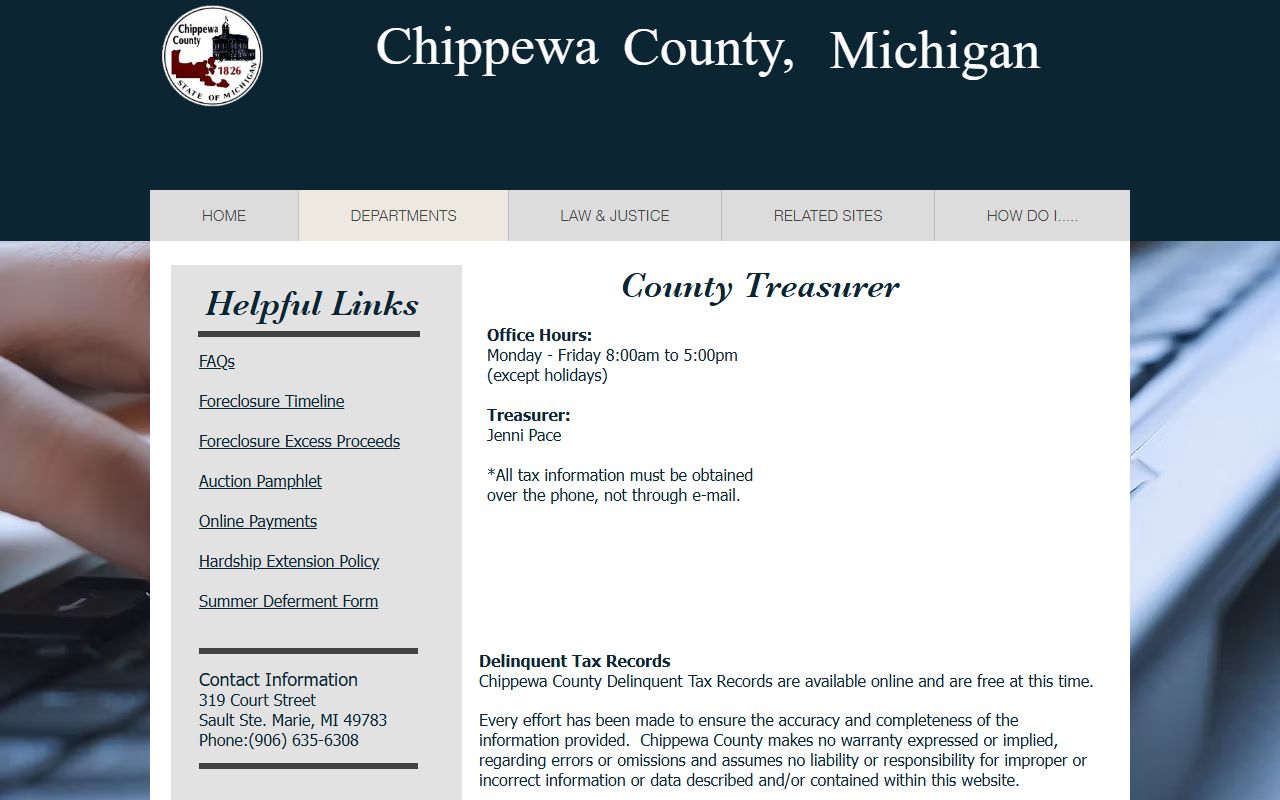
Call the office before making any delinquent tax payment to confirm the exact payoff amount, since fees and interest change daily.
The Chippewa County main website provides access to all county departments and services.
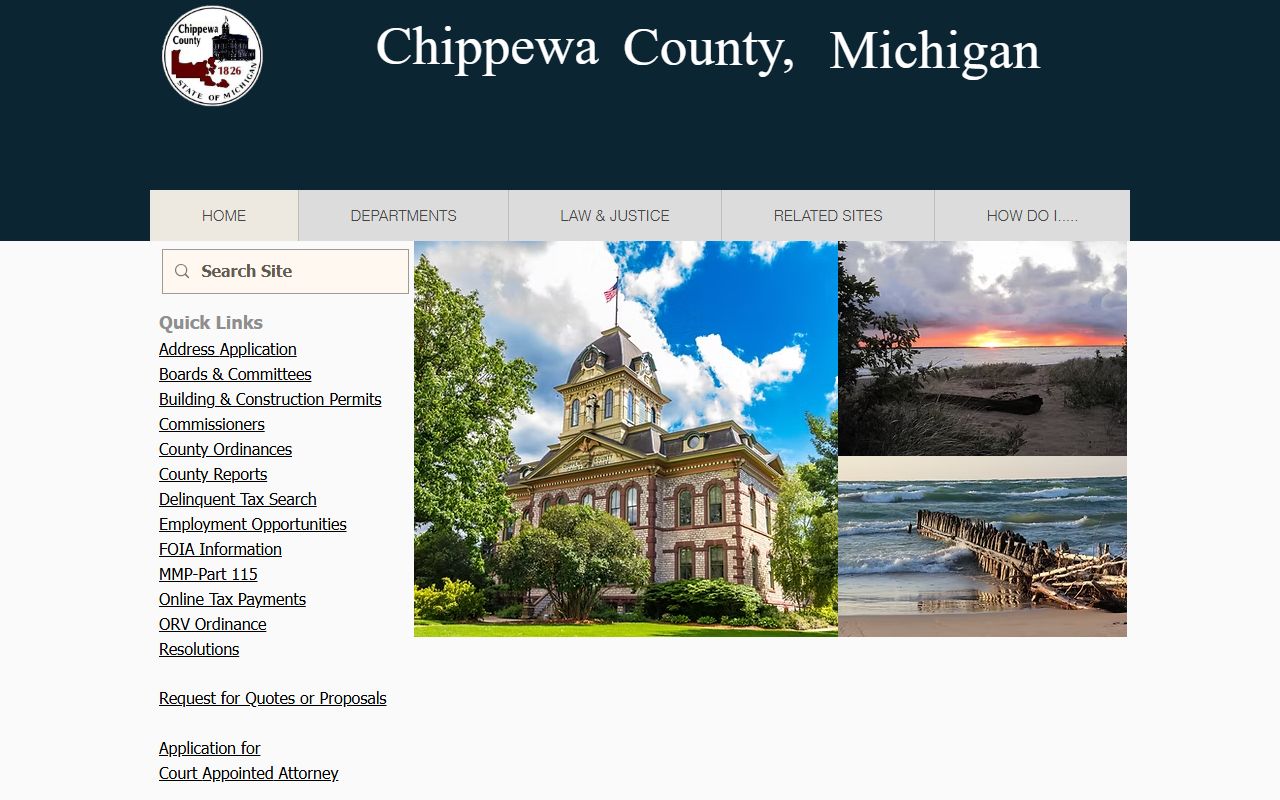
Use the county site to find current hours, locate specific departments, or access online services.
Tax Foreclosure Surplus Funds in Chippewa County
When Chippewa County forecloses on a property for unpaid taxes and sells it at auction, any amount left over after paying the taxes, fees, and costs belongs to the former owner or other parties with a legal interest. Michigan law, specifically MCL 211.78t, requires this. Counties cannot keep surplus proceeds from tax sales.
This was settled definitively by the Michigan Supreme Court in Rafaeli v. Oakland County in 2020. Before that ruling, counties kept all proceeds regardless of how much was left over after the tax debt was satisfied. That practice is no longer allowed.
Properties that are more than 24 months delinquent in Chippewa County go through a notification and title work process, after which a court orders the property to sale. If the sale produces surplus funds, those are available to be claimed under the following process for 2021 and later foreclosures:
Form 5743 - filed by July 1. This is the Claim for Excess Proceeds. You file it with the circuit court by July 1 of the year following the foreclosure sale to assert your legal interest in any surplus.
Accounting notice - received by January 31. The county treasurer sends you a written accounting of the sale proceeds, deductions for taxes and costs, and the net surplus amount.
CC540 court motion - filed February 1 through May 15. If you need to pursue your claim through the court, file a CC540 motion in this window. Missing this deadline typically means you lose the right to those funds.
The Chippewa County foreclosure excess proceeds information is available directly from the county. The Chippewa County foreclosure excess proceeds page explains the local process in more detail.
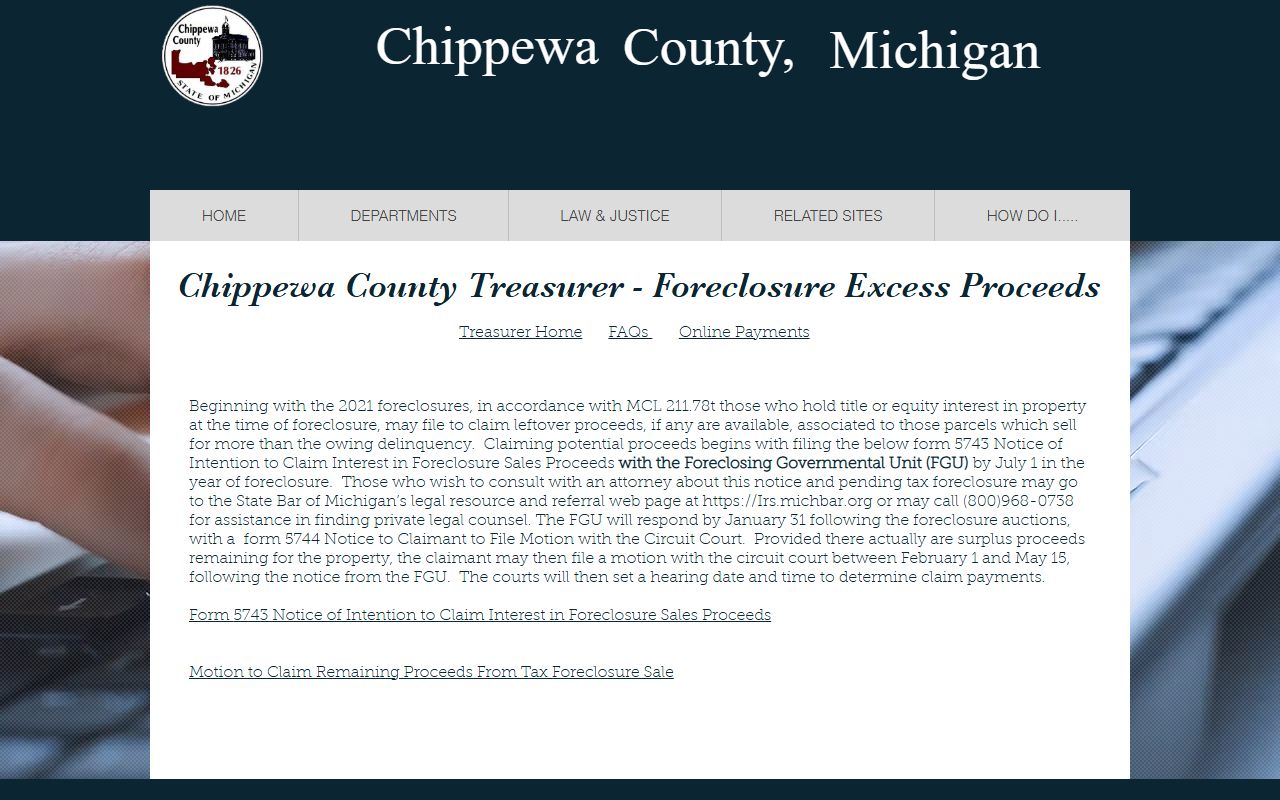
Review this page carefully if you believe you have a claim to surplus funds from a Chippewa County foreclosure sale.
Michigan Tax Foreclosure Timeline
Michigan's tax foreclosure process runs on a three-year cycle. Understanding the timeline helps you figure out where you stand and what options you still have to stop foreclosure or claim funds after a sale.
Year 1: Delinquency starts. When taxes go unpaid, they become delinquent on March 1 of the following year and move to the county treasurer's books. A 4% administrative fee is added to the unpaid balance, and 1% monthly interest starts accruing. Each month you wait, the balance grows.
Year 2: Forfeiture. On March 1 of the second year, the property is forfeited to the county treasurer. Forfeiture is not foreclosure. You haven't lost the property yet. But the interest rate jumps to 1.5% per month, applied retroactively to the original delinquency date. This can cause the total owed to increase substantially in a short period.
Year 3: Foreclosure judgment. On April 1 of year three, the circuit court enters a foreclosure order. The former owner's right to redeem the property by paying the balance is generally gone at this point. The property goes to the county land bank or to public auction.
If you're in the early stages of this process in Chippewa County, call Jenni Pace's office at (906) 635-6308 as soon as possible. Do not delay. Options narrow significantly as you move through the timeline.
Legal Aid Resources for Chippewa County
Michigan Legal Help at michiganlegalhelp.org has free guides covering tax foreclosure rights, how to file a surplus fund claim, and how to search for unclaimed property. The site is written for people without legal training and covers every step of the process.
State Bar of Michigan Lawyer Referral Service can connect you with an attorney who practices real estate or tax law. Call (800) 968-0738 or go to lrs.michbar.org. A small fee applies for the initial referral consultation.
Legal Services of Northern Michigan or other Upper Peninsula legal aid providers may serve Chippewa County residents based on income. Check michiganlegalhelp.org for a current list of free legal aid offices that cover the eastern Upper Peninsula region.
Michigan Homeowner Assistance Fund (MIHAF) may provide up to $25,000 to eligible homeowners with past-due property taxes or mortgage payments. Visit michigan.gov/mihaf to check eligibility and apply. Program funding is limited and can change, so check the site for current status.
Cities in Chippewa County
No cities in Chippewa County meet the 100,000-population threshold for a dedicated city page. Sault Ste. Marie is the county seat and the largest city in the county. All Chippewa County residents should use the state portal at unclaimedproperty.michigan.gov to search for unclaimed funds and contact the Treasurer at (906) 635-6308 for tax foreclosure surplus matters.