
Search Leelanau County Unclaimed Money
Leelanau County residents can search for unclaimed money through Michigan's free state database and may be owed surplus funds from tax foreclosure sales where the auction price exceeded the taxes and fees owed on the property. This northwestern Lower Peninsula county follows Michigan's standard foreclosure laws, and any former property owner with a qualifying 2021 or later foreclosure may have funds available to claim.
Leelanau County Overview
Michigan State Unclaimed Property Search
Michigan's Department of Treasury maintains a free database of unclaimed property at unclaimedproperty.michigan.gov. The system holds dormant bank accounts, uncashed checks, forgotten insurance proceeds, utility deposits, safe deposit contents, and other abandoned financial assets. You search by name. No fee. No registration. Michigan has returned more than $675 million to residents and continues to receive new assets each year as accounts go dormant.
Reach the unclaimed property team at (517) 636-5320 or TreasUPD@michigan.gov. Staff can confirm whether a database result belongs to you and walk you through the claim steps. The claim process itself costs nothing.
Michigan's free statewide unclaimed property search is available at unclaimedproperty.michigan.gov.
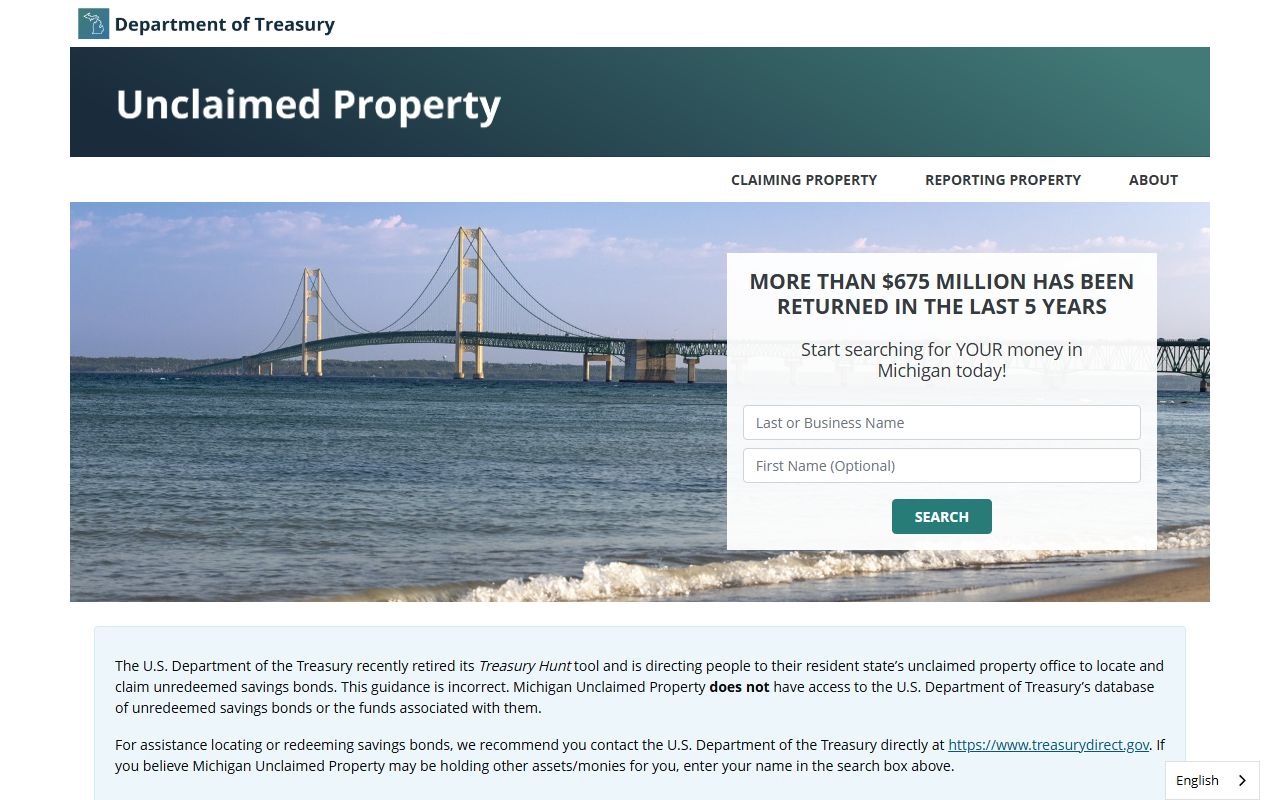
Search by name at no cost. No account required.
You can also search for deceased relatives. If a parent or grandparent held Michigan accounts at any point, their unclaimed funds may still be in the system. There is no deadline for filing once funds are held by the state.
About Leelanau County
Leelanau County sits on a peninsula in the northwestern Lower Peninsula, surrounded by Lake Michigan on two sides and Grand Traverse Bay on the third. The county seat is Suttons Bay. The area includes significant waterfront and vacation property, which can affect property values and the types of tax-related questions that arise. Seasonal and vacation property owners should be especially careful about ensuring taxes are paid on time, as delinquency timelines run regardless of whether you are in residence.
The Leelanau County Treasurer handles delinquent property tax collection and serves as the Foreclosure Government Unit for the county. For specific account questions, contact the Treasurer's office in Suttons Bay. The Michigan Department of Treasury at (517) 636-5320 can also assist with general questions about the foreclosure process and surplus claims.
Note: Waterfront and vacation properties in Leelanau County often carry higher assessed values than comparable inland properties. If your property was foreclosed and sold at auction, there is a meaningful chance the sale price exceeded the amount owed. That surplus may be available to claim under MCL 211.78t.
Tax Foreclosure Surplus Funds
Michigan law under MCL 211.78t gives former property owners the right to claim surplus proceeds from tax foreclosure sales that occurred in 2021 or later. Surplus is the amount by which the auction price exceeded the total taxes, interest, and fees owed. The claim requires action through the circuit court system and must meet specific deadlines.
Here is how the process works:
- File Form 5743 with the county's Foreclosure Government Unit (FGU) by July 1 of the year the property was sold at auction.
- The FGU reviews your claim and responds using Form 5744 by January 31.
- If the claim remains unresolved, file a motion in circuit court between February 1 and May 15.
- A judge reviews the claim at a scheduled hearing. If approved, payment follows within the timeline set by the court order.
The July 1 deadline for Form 5743 is firm. Missing it means losing your right to the surplus under the current law. If you are unsure whether you qualify or need help with the forms, reach out to a legal aid organization or attorney before the deadline passes.
For foreclosures that happened before 2021, the legal picture is less clear. The Michigan Supreme Court's ruling in Rafaeli v. Oakland County (2020) established that retaining surplus proceeds without compensating former owners was unconstitutional. Whether that protection extends retroactively to earlier foreclosures depends on individual case facts. Consulting an attorney is the best way to evaluate a pre-2021 claim.
Michigan's Three-Year Foreclosure Process
Michigan uses a structured three-year timeline for tax foreclosure. Each step has its own fees and its own window for redemption.
Taxes not paid by March 1 of the year after the due date become delinquent. A 4% administrative fee applies immediately, plus interest at 1% per month running from the original due date. The county treasurer takes over collection at this point.
If taxes remain unpaid by March 1 of the second year, the property enters forfeiture. This is not the same as losing the property. The owner still has time to pay, but interest climbs to 1.5% per month. A title search fee and recording fees are added to the total owed. These amounts are set at the county level. Despite the name, forfeiture just means the property has been flagged and the clock is running.
If no payment is made, the county files a petition for foreclosure in circuit court. Once the court enters a foreclosure judgment, the owner loses all rights to reclaim the property. The county takes title and prepares the property for auction. For foreclosures occurring in 2021 or later, any surplus from the auction may be claimed by the former owner through the MCL 211.78t process.
Tax Auction Information
Foreclosed properties in Leelanau County are typically auctioned through Tax-Sale.info. You can search listings and register to bid at tax-sale.info or call 800-259-7470 for help. Foreclosed property lists usually go up around July 1 ahead of the summer auction cycle.
Michigan law requires a Right of First Refusal process before any property goes to public auction. The State of Michigan has first access, followed by local units of government including townships and villages. Only properties not taken through that process proceed to public auction. Given the higher property values in Leelanau County, local governments may have more interest in acquiring certain properties before they reach public bidding.
Legal Help and Resources
Several free resources are available to Leelanau County residents who need help with unclaimed money, tax foreclosure, or surplus claims.
Michigan Legal Help offers a step-by-step guide on claiming money left over after a tax foreclosure. Find it at michiganlegalhelp.org. The guide covers Form 5743, the FGU process, and what to expect at a circuit court hearing.
Legal Services of Eastern Michigan (LSEM) provides free civil legal help to qualifying residents. Reach them at (800) 322-4512 or lsem-mi.org. They handle tax foreclosure surplus claims and related housing matters.
The State Bar of Michigan Lawyer Referral Service is at (800) 968-0738 or lrs.michbar.org. A referral connects you with a local attorney who handles your type of case.
The Michigan Homeowner Assistance Fund (MIHAF) at michigan.gov/mihaf may have programs to help homeowners catch up on delinquent taxes and avoid foreclosure. Program availability changes, so check the current status on their site.
Cities in Leelanau County
Leelanau County has no cities with populations above 100,000. Suttons Bay is the county seat. Other communities in the county include Leland, Lake Leelanau, and Cedar. All residents use the same county-level offices for property tax and foreclosure matters.
Nearby Counties
Leelanau County shares borders with several northern Lower Peninsula counties. Each handles its own tax foreclosure proceedings and surplus claims.