
Find Unclaimed Money in Grand Traverse County
Grand Traverse County residents can find unclaimed money through Michigan's statewide unclaimed property database and through the county's tax foreclosure surplus fund process under MCL 211.78t. The Michigan Department of Treasury holds more than $675 million in unclaimed funds for Michigan residents and businesses, and some of that belongs to people in the Traverse City area who have never filed a claim. Treasurer Sarah Gum's office at 400 Boardman Avenue handles delinquent taxes and foreclosure surplus matters, and the county uses tax-sale.info for public auctions, with the State of Michigan holding first right of refusal on foreclosed properties before they go to public sale.
Grand Traverse County Overview
Michigan State Unclaimed Property Search
Start your search at unclaimedproperty.michigan.gov. The Michigan Department of Treasury runs this database and the search costs nothing. You don't need an account. Just enter your name and check the results.
The database contains all types of unclaimed financial property reported to the state by banks, employers, insurance companies, utilities, and other businesses. Common finds include dormant checking and savings accounts, uncashed payroll checks, life insurance proceeds, stock dividends, utility deposit refunds, and unclaimed tax refunds. Michigan law requires companies to report and transfer these dormant assets to the state after a set inactivity period. Once the state has them, there is no deadline to claim what's yours.
When you're ready to file a claim, gather a government-issued photo ID and documentation linking you to the original property. An old bank statement, W-2, utility bill, or pay stub usually works. Larger claims often require notarized forms. Standard processing time is 60 to 90 days from the date a complete claim is submitted.
For questions or to check a claim's status: call (517) 636-5320 or email TreasUPD@michigan.gov.
The Michigan Unclaimed Property portal covers all counties including Grand Traverse. The portal is shown below.
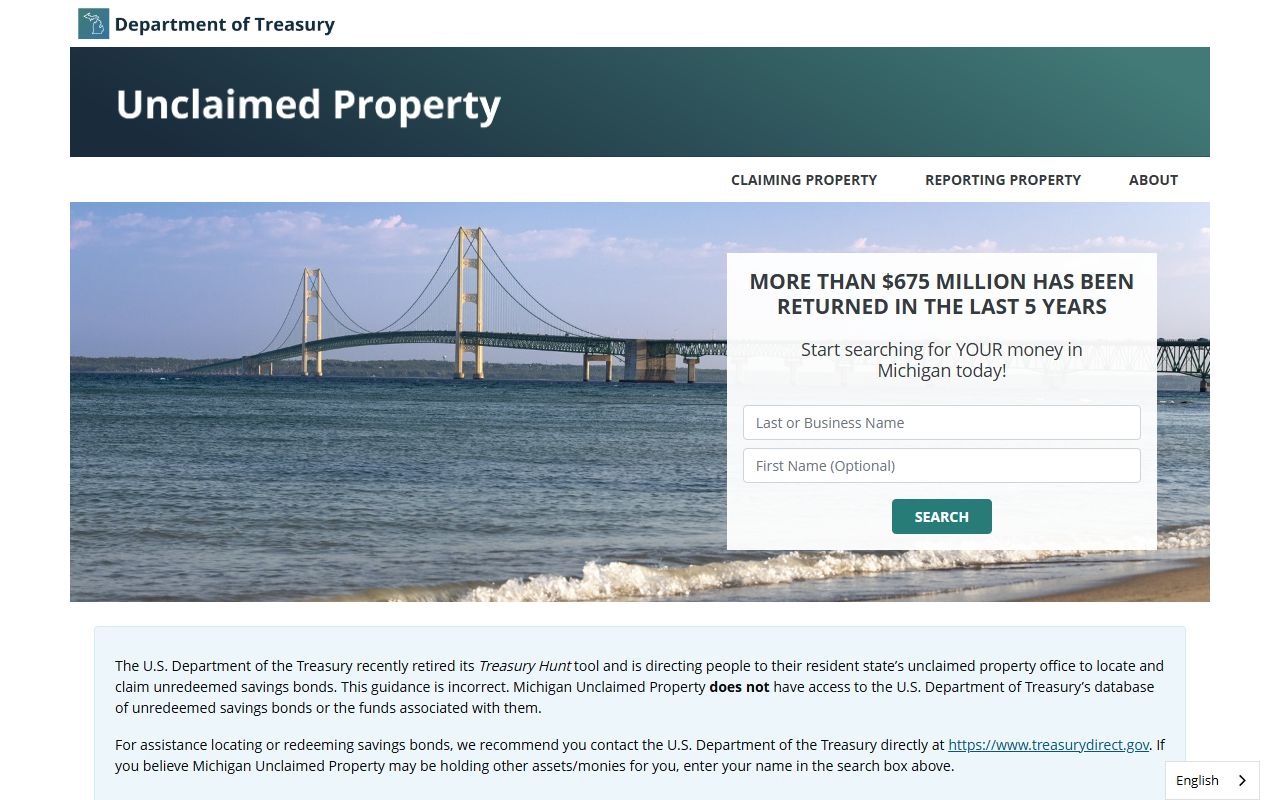
It's worth checking again if you searched before. New accounts are added throughout the year as businesses file annual reports.
Grand Traverse County Treasurer
Grand Traverse County Treasurer Sarah Gum oversees the county's delinquent tax collection and tax foreclosure process. The office is at 400 Boardman Avenue, Suite 104, Traverse City, MI 49684.
Phone: (231) 922-4735
Fax: (231) 922-4658
Email: treasurer@gtcountymi.gov
The Treasurer's office collects delinquent taxes forwarded from the county's townships and issues Settlement History reports to township boards. The office manages the full tax foreclosure process under Act 123 of 1999. Municipalities served by the Treasurer's office include Acme, Blair, East Bay, Fife Lake, the Village of Fife Lake, Garfield, Grant, Green Lake, Long Lake, Mayfield, Paradise, Peninsula, Union, and Whitewater townships.
When a property in Grand Traverse County is foreclosed, the State of Michigan holds the right of first refusal to purchase the property at the minimum bid. If the state declines, the municipality where the property is located has preference to purchase it next. Only after both the state and municipality decline does the property proceed to public auction through tax-sale.info.
If you have received a delinquency or forfeiture notice from the Treasurer's office, contact the office at (231) 922-4735 right away to get the exact payoff amount. Do not estimate what you owe. The balance changes monthly due to interest, and an underpayment can leave the account open.
The Grand Traverse County website is shown below. Visit the Grand Traverse County main website for access to all county departments.
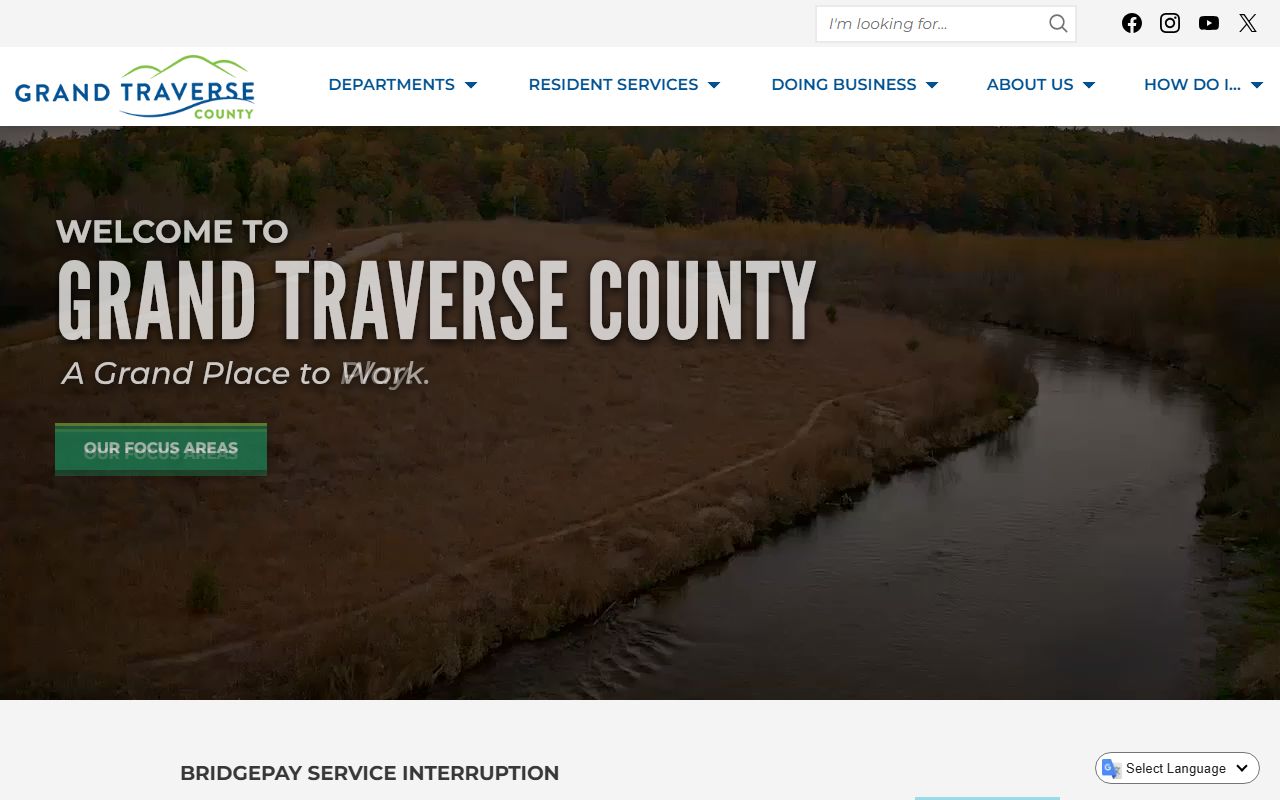
Use the county site to find updated hours, department contacts, and any announcements about tax sales or foreclosure hearings.
The Treasurer's specific page is available at the Grand Traverse County site. The Grand Traverse County Treasurer page provides detailed information on delinquent tax procedures.
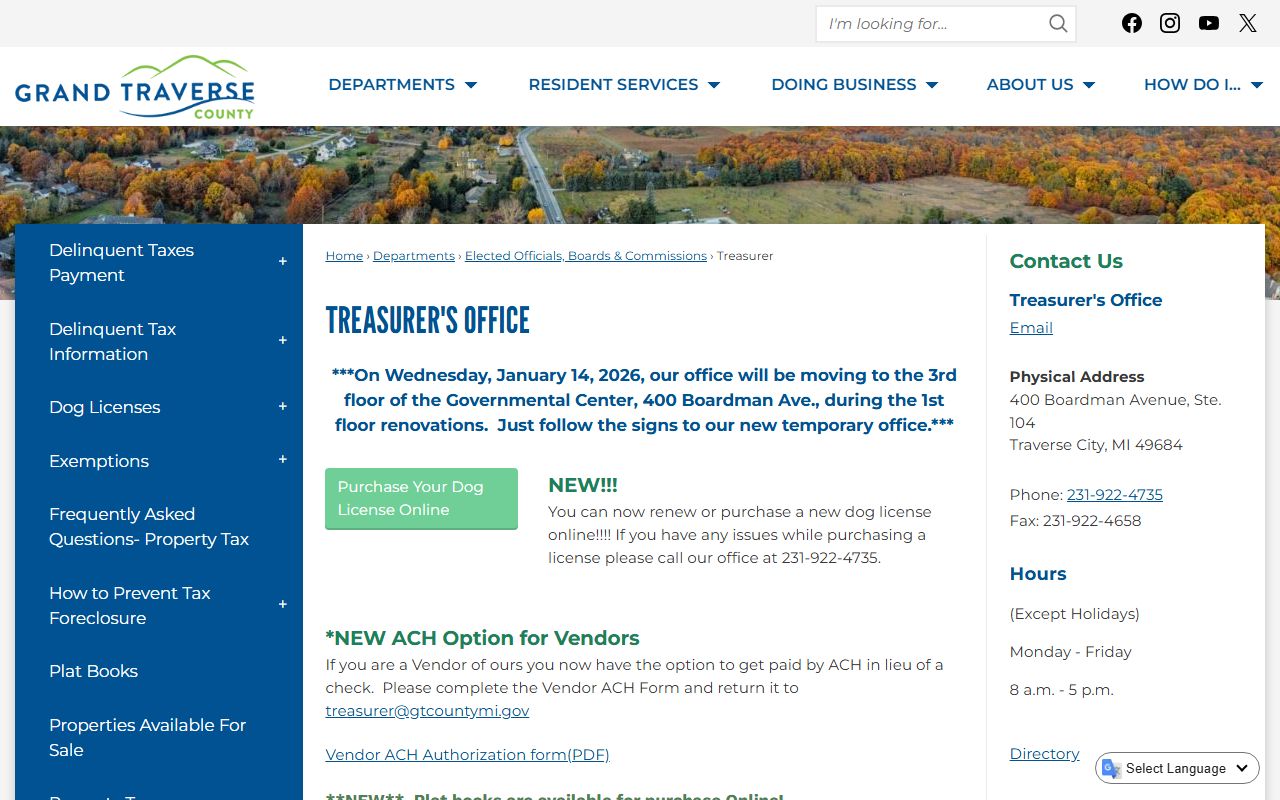
Check the Treasurer page for current procedures on delinquent tax payments, foreclosure timelines, and surplus fund claims.
Tax Foreclosure Surplus Funds in Grand Traverse County
When Grand Traverse County forecloses on a property and the subsequent auction sale produces more than what was owed in taxes, fees, and costs, the surplus belongs to the former property owner or other legal claimants. This is required under Michigan law at MCL 211.78t, and it was confirmed by the Michigan Supreme Court in Rafaeli v. Oakland County in 2020. Counties cannot retain those surplus proceeds.
For properties foreclosed in 2021 and later in Grand Traverse County, here is the process to claim surplus funds:
Form 5743 filed by July 1. The Claim for Excess Proceeds form is filed with the circuit court by July 1 of the year following the foreclosure sale. This form notifies the court that you have a legal interest in any surplus from that specific sale.
Accounting notice by January 31. After Form 5743 is on file, the Treasurer must send a written accounting that shows the total sale proceeds, amounts deducted for taxes and fees, and the net surplus amount available to be claimed.
CC540 court motion between February 1 and May 15. If you need to take your claim to court, the CC540 motion must be filed within this window. The May 15 cutoff is firm. Missing it typically ends your ability to pursue those funds.
Grand Traverse County tax auctions are conducted through tax-sale.info, with the state and municipality getting first purchase rights before properties move to public auction. If a sale generated surplus funds and you had an interest in the property, contact the Treasurer's office at (231) 922-4735 to start the claim process.
Michigan Tax Foreclosure Timeline
Michigan's property tax foreclosure process runs on a three-year timeline. Here is what happens at each stage.
Year 1: Delinquency begins. When taxes go unpaid past the due date, they remain with the local township or city until March 1 of the following year, when they transfer to the county treasurer. At that point, a 4% administrative fee is added and 1% monthly interest starts to accrue.
Year 2: Forfeiture. On March 1 of year two, the property is forfeited to the county treasurer. The owner still has the legal right to pay and keep the property. But interest increases to 1.5% per month, calculated retroactively from the original delinquency date. This can cause the outstanding balance to jump significantly when forfeiture is entered.
Year 3: Foreclosure judgment. On April 1 of year three, the circuit court enters a foreclosure order. The owner's right to pay and redeem the property is generally gone at this point. The Treasurer issues title to the county land bank or puts the property through public auction.
Act now if you're in the delinquency or forfeiture stage. Call Treasurer Gum at (231) 922-4735 to find out your exact balance and what options remain. Payment plans may be available depending on your circumstances.
Legal Aid Resources for Grand Traverse County
Michigan Legal Help at michiganlegalhelp.org provides free, plain-language guides on tax foreclosure, surplus fund claims, and unclaimed property. The guides walk through the process step by step, explain what forms to file, and list relevant deadlines for Michigan property owners.
State Bar of Michigan Lawyer Referral Service: Call (800) 968-0738 or visit lrs.michbar.org to be matched with a licensed attorney in the northwest Michigan area who handles real estate or tax law. A small fee applies for the initial consultation referral.
Legal aid organizations in northwest Michigan may serve Grand Traverse County residents at no cost based on income. Check michiganlegalhelp.org for a current directory of free legal services covering Traverse City and surrounding counties.
Michigan Homeowner Assistance Fund (MIHAF) may provide up to $25,000 for eligible homeowners who are behind on property taxes or other housing costs. Visit michigan.gov/mihaf for current eligibility information and to apply. Check the site promptly since funding availability changes.
Cities in Grand Traverse County
No cities in Grand Traverse County meet the 100,000-population threshold for a dedicated city page. Traverse City is the county seat and the largest city. All Grand Traverse County residents should search at unclaimedproperty.michigan.gov for state unclaimed property and contact the Treasurer at (231) 922-4735 for any tax foreclosure surplus questions.