
Iron County Unclaimed Property Lookup
Iron County residents in the Upper Peninsula may have unclaimed money held by the State of Michigan, including dormant bank accounts, insurance proceeds, forgotten utility deposits, and tax foreclosure surplus funds. The Michigan Department of Treasury holds over $675 million statewide, and searching is free. Tax foreclosure has been a significant issue in Iron County, and former property owners may be owed surplus funds from auctions. Fewer than 10% of property owners successfully navigate Michigan's surplus claim procedure without legal help, making it essential to understand the process and get assistance early.
Iron County Overview
Michigan State Unclaimed Property Search
The Michigan Department of Treasury holds unclaimed funds reported by banks, credit unions, insurance companies, utilities, and other businesses. Once an account or fund goes dormant, the business is required to report it to the state. The state then holds the money indefinitely, waiting for the owner or their heirs to file a claim.
The search is free. Go to unclaimedproperty.michigan.gov and enter your name. The site shows what's there. If you find a match, file the claim online. Most are resolved within 90 days. Call (517) 636-5320 or email TreasUPD@michigan.gov with questions.
The Michigan Unclaimed Property portal shown below is the primary tool for Iron County residents. It covers all types of dormant accounts and unclaimed funds statewide.
Visit unclaimedproperty.michigan.gov to run a free search by name.
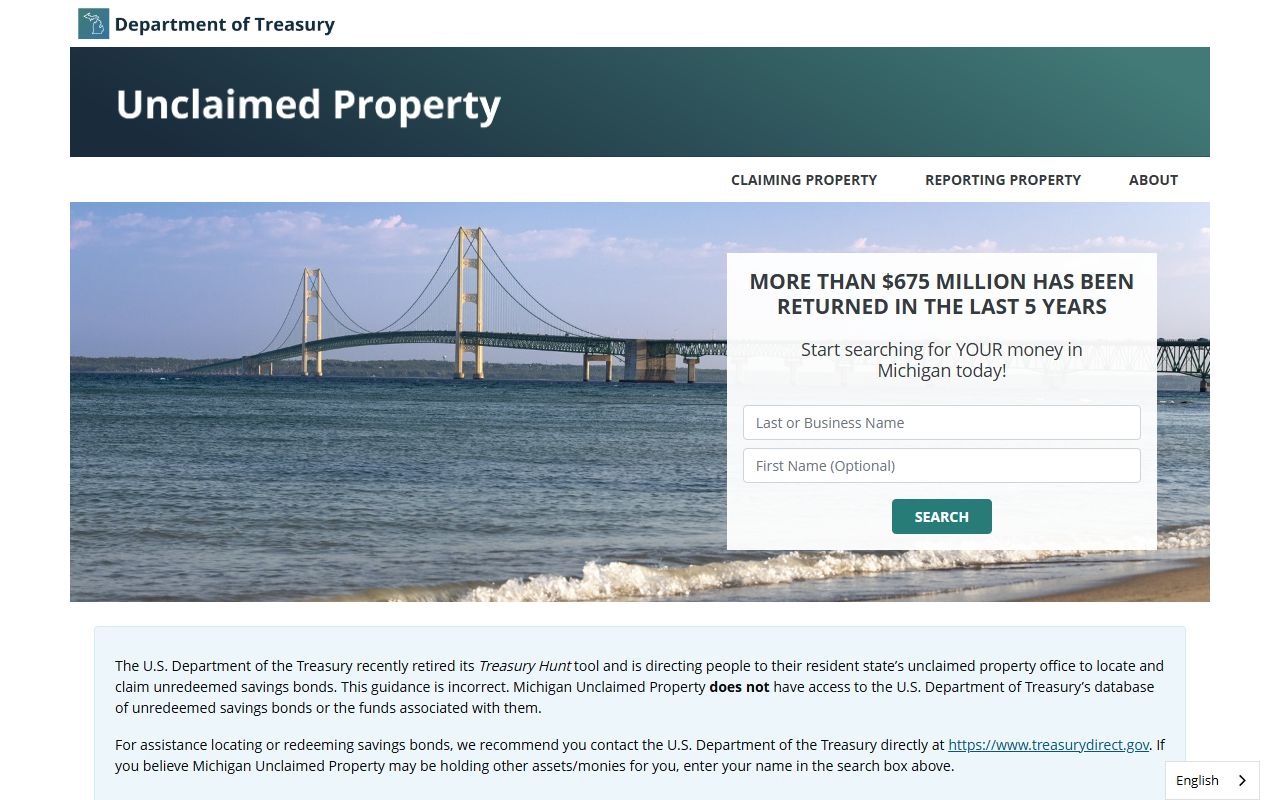
Search under every name you've used and check for deceased family members. Heirs can often claim funds held in a deceased person's name, especially for recent deaths.
Common Types of Unclaimed Property
Bank accounts are the most common type, but there are many others. Old insurance policies, stock dividends that were never cashed, security deposits, court-ordered refunds, and safe deposit box contents all end up with the state when the owner can't be found. If you moved, changed banks, or lost track of old accounts, it's worth a quick search. The state holds these funds indefinitely, so even old claims can be filed.
Iron County Treasurer
The Iron County Treasurer acts as the Foreclosing Governmental Unit (FGU) under Michigan law. This means the Treasurer is directly responsible for proceedings to foreclose on property when real estate taxes go unpaid. The process is governed by Michigan's General Property Tax Act, and Iron County follows the standard three-year timeline before a final judgment is entered.
Foreclosure notices and property lists are published in the Iron County Reporter, a local newspaper designated for legal notices. If your property was listed there for unpaid taxes, check whether the foreclosure auction generated a surplus.
| County Seat | Crystal Falls, MI |
|---|---|
| Region | Upper Peninsula |
| Foreclosing Unit | Iron County Treasurer (FGU) |
| Legal Notice Publication | Iron County Reporter |
Legal Notices and Foreclosure Lists
Michigan law requires the foreclosing unit to publish notices in a local newspaper before a property can be foreclosed. In Iron County, these run in the Iron County Reporter. The foreclosure lists include property owner names, parcel numbers, and the amount of taxes owed. If you received a notice or saw your name in these lists, you were in the foreclosure process. If you lost the property and the auction price was higher than what you owed, a surplus may exist for you to claim.
Tax Foreclosure Surplus Funds in Iron County
When a foreclosed property sells at auction for more than the debt owed, the difference is a surplus. Under Michigan Compiled Laws section 211.78t, the former owner has a legal right to claim that surplus. The process has strict deadlines, and very few people navigate it successfully without help. Fewer than 10% of property owners in Michigan successfully file surplus claims on their own, according to legal aid observations. Getting help early matters.
Claim Forms and Deadlines
The two main forms for surplus claims are:
- Form 5743 - Notice of intention to claim. Must be filed by July 1 of the foreclosure year.
- Form 5744 - Petition to claim surplus proceeds. Due by January 31 after the foreclosure sale.
If those windows are closed, form CC540 is a court motion option that runs from February 1 through May 15. This is filed with the circuit court. The judge reviews the claim and orders the county to pay if the claim is valid. This is not an easy path, but it keeps the option open for people who missed the earlier deadlines.
Rafaeli v. Oakland County (2020)
The Michigan Supreme Court's 2020 Rafaeli decision established that former property owners are entitled to surplus proceeds from tax foreclosure auctions. Counties cannot keep the excess. This ruling applies statewide, including Iron County. If your property was foreclosed in recent years and the auction price exceeded what you owed, you may be owed a surplus.
In re Petition of Alger: U.S. Supreme Court Decision
A notable case involving Iron County reached the U.S. Supreme Court. In re Petition of Alger involved Iron County Treasurers and a foreclosure process that highlighted the complexity of surplus claims. The case involved Jacqueline McGee, whose home was foreclosed just 10 days after her death. The U.S. Supreme Court denied certiorari in January 2026, leaving the lower court ruling in place. This case underscores how the system can catch vulnerable people off guard, and why getting legal help early in the foreclosure process is critical.
Michigan Tax Foreclosure Timeline
Michigan law requires a three-year process before foreclosure is final. Here's how it works:
- Year 1: Taxes go unpaid. On March 1, the county treasurer takes over collection. A lien attaches to the property and interest begins. The owner can still pay to stop the process.
- Year 2: The property is formally listed as delinquent. Notices are sent. Redemption rights remain. Formal foreclosure proceedings begin at the circuit court.
- Year 3: If taxes are still unpaid, the circuit court enters a foreclosure judgment. The property is auctioned. The Iron County Treasurer manages the auction as the FGU.
After the auction, the debt, fees, and costs are paid from the proceeds. Whatever remains is the surplus. The former owner has a right to claim it under MCL 211.78t, but only within the filing windows. Miss the deadline and the right to claim is gone.
For a remote county like Iron, these timelines matter because legal help is less accessible. Using Michigan Legal Help's online guides can fill some of that gap for residents who can't easily travel to see an attorney.
Legal Aid Resources for Iron County Residents
Iron County is remote, which makes accessing legal help harder than in urban areas. But there are free and low-cost options available, including online and phone resources.
Michigan Legal Help
Visit michiganlegalhelp.org for free step-by-step guides on surplus claims, tax foreclosure, and unclaimed property. The site is available 24/7, covers the correct forms and deadlines, and has guides for representing yourself in court when needed. For remote Upper Peninsula residents, this is often the most practical first resource.
State Bar of Michigan Lawyer Referral Service
Call (800) 968-0738 or visit lrs.michbar.org to reach the State Bar referral service. They can connect you with attorneys who handle property law and tax foreclosure matters. Some attorneys offer phone or video consultations, which helps Iron County residents who can't easily travel. Initial consultations are often low-cost or free.
Michigan Homeowner Assistance Fund
If you're currently behind on property taxes, visit michigan.gov/mihaf to check the Michigan Homeowner Assistance Fund (MIHAF). This program can pay off delinquent tax balances and stop a foreclosure before it progresses. Stopping the foreclosure is always the better outcome compared to trying to claim a surplus later.
Act quickly on any surplus claim. The July 1 and January 31 deadlines are hard cutoffs. The court motion window closes May 15. If you're past one deadline, check whether another option still applies before assuming all is lost.
Cities in Iron County
Crystal Falls is the county seat. Iron River is the largest city in the county. No cities in Iron County meet the population threshold for a dedicated city page on this site. Residents throughout Iron County can use the state portal and the resources on this page to search for unclaimed property and pursue surplus fund claims through the circuit court.