
Gogebic County Unclaimed Property Search
Gogebic County residents in Michigan's western Upper Peninsula can search for unclaimed money through the Michigan Department of Treasury's statewide property database and through the county's tax foreclosure surplus fund process. The state currently holds more than $675 million in unclaimed funds, and that total includes money belonging to people in the Bessemer area who haven't yet filed a claim. Gogebic County follows Michigan's standard tax foreclosure procedures under Public Act 123 of 1999, which means former property owners may be owed surplus proceeds from any foreclosure auction that generated more than the amount owed in taxes and fees. This page covers how to search both programs and what to expect.
Gogebic County Overview
Michigan State Unclaimed Property Search
The best place to start is unclaimedproperty.michigan.gov. This free database is run by the Michigan Department of Treasury. You don't need to register or pay anything. Just type your name and see what the state is holding for you.
The database contains a wide range of financial property that companies reported as unclaimed: bank accounts that went dormant, payroll checks that were never cashed, insurance proceeds that couldn't be delivered, stock dividends, utility deposit refunds, and more. Under Michigan law, businesses must hand these assets over to the state after one to three years of inactivity. Once the state has them, there is no deadline for you to claim what's yours.
To file a claim, you need a government-issued photo ID and some form of documentation linking you to the original property. An old bank statement, a W-2, a pay stub, or a utility bill from the right address typically satisfies this requirement. Larger dollar claims often need notarized paperwork. Once you submit a complete claim, the Treasury processes it in about 60 to 90 days.
For help or to check claim status, call (517) 636-5320 or email TreasUPD@michigan.gov.
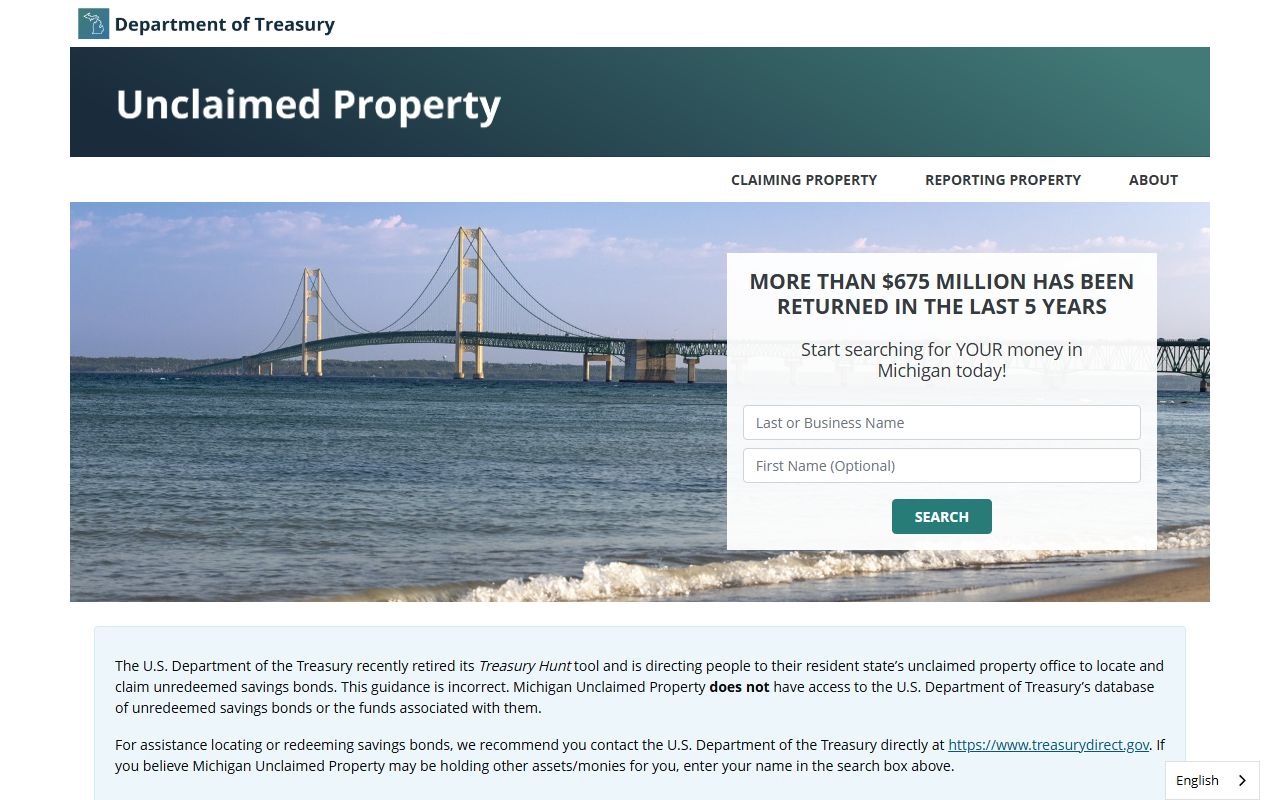
The Michigan unclaimed property search portal is the central database for all Michigan counties, including Gogebic County. The Michigan Unclaimed Property site is shown below.
Check every year or so. New accounts are added to the database on an ongoing basis as companies submit annual reports to the state.
Gogebic County Treasurer
The Gogebic County Treasurer's office is located in Bessemer, the county seat, and handles all delinquent property tax collection and tax foreclosure proceedings for the county. For current contact information, phone numbers, and office hours, visit the Gogebic County website at gogebiccounty.org.
Gogebic County is one of Michigan's western Upper Peninsula counties, sharing a border with Wisconsin to the west. It is bounded by Ontonagon County to the north and Iron and Dickinson counties to the east. The county follows Michigan's standard property tax laws under the General Property Tax Act.
When property taxes go unpaid in Gogebic County, they transfer to the county treasurer on March 1 of the following year. A 4% administrative fee is added at that point, and monthly interest begins accruing. If you are behind on property taxes, contact the Gogebic County Treasurer's office directly to get an exact payoff figure and to ask about your options. Do not estimate what you owe. The fees and interest are calculated precisely, and an underpayment can leave the account open and the foreclosure process continuing.
Delinquent tax records for the county may be available online, or you may need to call the Treasurer's office directly. Contact the office to confirm current payment methods accepted and hours of operation.
Tax Foreclosure Surplus Funds in Gogebic County
Michigan law under MCL 211.78t (part of Public Act 123 of 1999) requires that any surplus from a tax foreclosure sale be returned to the former owner or other parties with a legal interest in the property. If Gogebic County sells a foreclosed property at auction for more than the amount owed in taxes, fees, and administrative costs, that excess belongs to you, not the county.
The Michigan Supreme Court's 2020 ruling in Rafaeli v. Oakland County made this right explicit. Before that case, counties kept all proceeds. Now they can't. Former owners have a clear legal path to claim surplus funds from sales that occurred in 2021 and later.
The standard MCL 211.78t surplus claim process applies in Gogebic County:
File Form 5743 by July 1. The Claim for Excess Proceeds form must be filed with the circuit court by July 1 of the year following the foreclosure auction. This filing puts the court on notice that you have a legal interest in any surplus from the sale.
Accounting notice by January 31. The county treasurer must send a written accounting showing what the property sold for, what amounts were deducted for taxes and fees, and the net surplus remaining.
CC540 court motion between February 1 and May 15. If you need to pursue the claim in court, file the CC540 motion within this window. Missing the May 15 deadline typically forfeits your right to claim those funds.
If you believe you are owed surplus funds from a Gogebic County tax foreclosure sale, contact the Treasurer's office and consider consulting with a real estate attorney to understand your rights and the applicable deadlines.
Michigan Tax Foreclosure Timeline
Michigan uses a three-year process to move a property through delinquency to foreclosure. Here is how each year works and what you can still do at each stage.
Year 1: Delinquency. Taxes go unpaid. On March 1 of the following year, those taxes transfer to the county treasurer's books. A 4% fee is added to the balance. Monthly interest at 1% starts running. Every month without payment increases the total owed.
Year 2: Forfeiture. On March 1 of year two, the property is forfeited to the county treasurer. This is not the same as foreclosure. You still own the property and can still pay to keep it. But the interest rate increases to 1.5% per month, applied retroactively to the original delinquency date. The sudden retroactive calculation can cause a large jump in the amount owed.
Year 3: Foreclosure judgment. On April 1 of year three, the circuit court enters a foreclosure order. At this point, the former owner's right to pay and reclaim the property is generally terminated. The property is transferred to the county land bank or sold at public auction.
At any point in the first two years, you can stop the process by paying the full amount owed. Contact the Gogebic County Treasurer's office to get the exact payoff figure and ask about any available payment plan options. Hardship extensions may also be available in some cases, though interest and fees continue to accrue during an extension.
Legal Aid Resources for Gogebic County
Michigan Legal Help at michiganlegalhelp.org has free, step-by-step guides for residents facing tax foreclosure, surplus fund claims, or unclaimed property questions. The guides are written for non-lawyers and explain what forms to file, what deadlines apply, and how court procedures work.
State Bar of Michigan Lawyer Referral Service: Call (800) 968-0738 or visit lrs.michbar.org. They can refer you to a licensed attorney handling real estate or tax law in your area. There is a modest fee for the initial consultation referral.
Upper Peninsula legal aid organizations may serve Gogebic County residents at no cost or reduced cost based on income. Visit michiganlegalhelp.org for a directory of legal aid offices that cover western Upper Peninsula communities including the Bessemer area.
Michigan Homeowner Assistance Fund (MIHAF) may offer up to $25,000 for eligible homeowners with past-due property taxes. Visit michigan.gov/mihaf to check current eligibility and apply. Funding availability changes, so check early if you think you qualify.
Cities in Gogebic County
No cities in Gogebic County meet the 100,000-population threshold for a dedicated city page. Bessemer is the county seat. Ironwood and other Gogebic County communities are served by the statewide portal at unclaimedproperty.michigan.gov for unclaimed property searches. Contact the Gogebic County Treasurer directly for questions about tax foreclosure surplus funds.