
Search Oceana County Unclaimed Money
Oceana County residents may have unclaimed money held by the Michigan Treasury or surplus funds left over from tax foreclosure sales. This page covers how to search the state database, how the county treasurer handles delinquent taxes, and what steps to take if you believe you are owed money from a past property foreclosure in Hart or anywhere else in the county.
Oceana County Overview
Michigan State Unclaimed Property Search
Search Michigan's free statewide unclaimed property database at unclaimedproperty.michigan.gov.
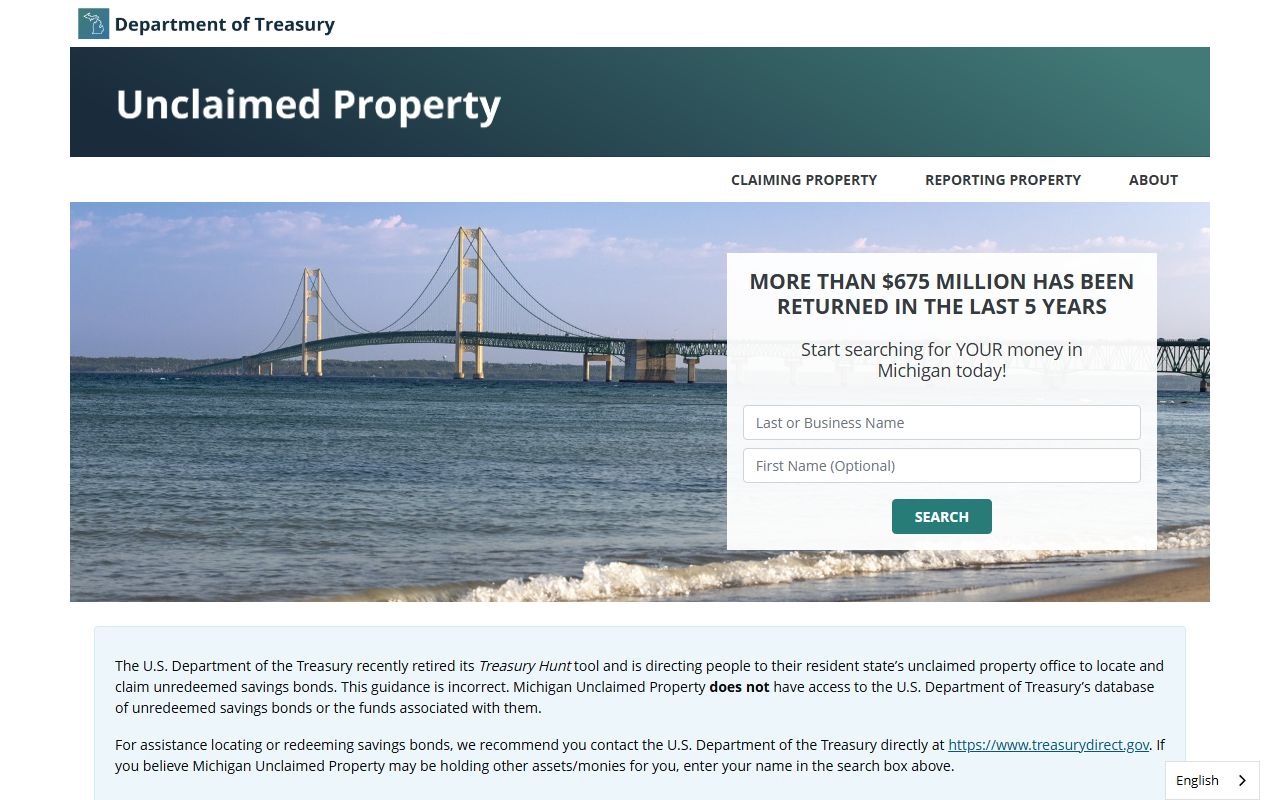
The database holds $675 million in unclaimed funds. Search is free and takes only a few minutes.
The Michigan Department of Treasury runs the unclaimed property program under the Uniform Unclaimed Property Act. Banks, insurance companies, employers, and other businesses must send dormant accounts and uncashed checks to the state after a set period of inactivity, usually three to five years. Once the state receives those funds, they are held indefinitely. There is no deadline to file a claim.
Common types of unclaimed property include forgotten bank accounts, uncashed payroll checks, insurance proceeds, utility deposits, and safe deposit box contents. You can search by name, business name, or address. If you find a match, you file a claim online or by mail and provide proof of identity. Most claims are paid within 90 days.
For help, contact the Michigan Treasury unclaimed property division at (517) 636-5320 or by email at TreasUPD@michigan.gov. Staff can answer questions about claim status, required documents, and the overall process.
Oceana County Treasurer
The Oceana County Treasurer's office in Hart handles delinquent property tax collection and manages tax foreclosure proceedings for the county. If you have questions about a specific parcel, a past foreclosure, or a potential surplus from a tax sale, the treasurer's office is the right starting point.
| Office | Oceana County Treasurer |
|---|---|
| Address | 100 S. State St., Hart, MI 49420 |
| County Seat | Hart, Michigan |
| County Code | 64 |
| Website | oceana.mi.us |
The treasurer collects delinquent taxes that were not paid to the township treasurers by the end of February each year. Once taxes become delinquent at the county level, interest and fees begin to accrue. The treasurer's office works through a structured three-year process before a property can be foreclosed and sold at auction.
Tax Foreclosure Surplus Funds in Oceana County
When a property is foreclosed for unpaid taxes and then sold at auction for more than what was owed, the extra money is called a surplus. Under Michigan law, specifically MCL 211.78t, the former owner or other parties with a legal interest in the property may be entitled to claim those surplus proceeds.
The Michigan Supreme Court addressed this issue directly in the 2020 Rafaeli v. Oakland County decision. The court held that taking surplus proceeds from a tax sale without compensating the former owner violated the Michigan Constitution. Following that ruling, the state legislature updated the law to create a formal process for claiming surplus funds.
Oceana County is one of several counties that was part of a class action lawsuit over this issue. Docket No. 349633 included Oceana along with Newaygo, Benzie, Manistee, Wexford, Missaukee, Mason, Lake, and Osceola Counties. That litigation helped establish clearer rules for how surplus claims are handled across these counties.
To claim surplus funds from a past Oceana County tax foreclosure, you need to act quickly. There are strict deadlines under MCL 211.78t. Miss them and you may lose your right to the money.
Key Forms and Deadlines
| Form 5743 | Notice of Intent to Claim Interest in Foreclosure Surplus - due by July 1 in the year of foreclosure |
|---|---|
| Form 5744 | Claim for Foreclosure Surplus Proceeds - due by January 31 following the foreclosure year |
| Form CC540 | Circuit Court petition for surplus - filed February 1 through May 15 |
| Key Statute | MCL 211.78t - exclusive mechanism for claiming surplus proceeds |
It is important to understand that MCL 211.78t provides the only legal path for making these claims. Courts have held this statute is the exclusive mechanism, meaning you cannot use other legal theories to seek the same money outside of this process.
Michigan Tax Foreclosure Timeline
Michigan uses a three-year process before a property reaches foreclosure. Understanding this timeline helps you know when to act and what notices to watch for.
| Year 1 | Property taxes go unpaid to township; county treasurer takes over the delinquent tax account on March 1 |
|---|---|
| Year 2 | Property enters forfeiture status on March 1; county treasurer records a forfeiture certificate; redemption amount increases with added fees and interest |
| Year 3 | Foreclosure petition filed; circuit court issues a judgment of foreclosure; property vests in county on March 31 if taxes remain unpaid |
| After Foreclosure | County holds or sells property at auction; any sale proceeds above the tax debt may be claimed by former owner under MCL 211.78t |
Forfeiture does not mean you have lost the property yet. During the forfeiture period you still have time to redeem by paying the full amount owed. Foreclosure is the final step, and it only happens if the taxes are not paid by the end of the redemption period.
Show Cause hearings are scheduled by the county as part of the foreclosure process. These give property owners a chance to appear before a judge and present any reasons why foreclosure should not proceed. If you receive a notice of a Show Cause hearing, you should attend or contact an attorney.
Other Sources of Unclaimed Money in Oceana County
Beyond the state database and tax foreclosure surplus, there are other places where Oceana County residents might find money owed to them.
The U.S. courts system holds unclaimed funds from federal cases, including bankruptcy proceedings. If you were a creditor in a federal bankruptcy case filed in the Western District of Michigan, there may be unclaimed distributions. You can search the federal court's registry through the PACER system or by contacting the clerk of court directly.
Pension funds and retirement accounts sometimes go unclaimed when workers change jobs or lose contact with a former employer. The Department of Labor's Abandoned Plan database and the Pension Benefit Guaranty Corporation (PBGC) are worth checking. Both offer free online searches.
Life insurance policies are another overlooked source. The Michigan Department of Insurance and Financial Services (DIFS) can provide guidance if you believe a deceased family member had a policy that was never claimed.
Veterans benefits may also go unclaimed. The U.S. Department of Veterans Affairs and the Michigan Veterans Affairs Agency both offer assistance programs. Contact the Michigan Veterans Affairs Agency at 1-800-MICH-VET for help.
Legal Aid and Help for Oceana County Residents
If you need help navigating the claims process, several free and low-cost resources are available to Oceana County residents.
| Michigan Legal Help | michiganlegalhelp.org - free legal information and tools for the public |
|---|---|
| Lawyer Referral Service | lrs.michbar.org - State Bar of Michigan referral line: (800) 968-0738 |
| Michigan HAF | michigan.gov/mihaf - Homeowner Assistance Fund for mortgage and tax help |
Michigan Legal Help has a specific guide titled "How to Ask For Your Leftover Money After a Tax Foreclosure." This guide walks through each step of the MCL 211.78t process in plain language. It explains what forms to file, where to file them, and what to expect at a court hearing. It is a good starting point if you think you may have a surplus claim.
The State Bar of Michigan's Lawyer Referral Service can connect you with an attorney who handles property tax and foreclosure matters. The first consultation is typically available at a reduced fee.
Cities in Oceana County
Oceana County includes the city of Hart (county seat) and several smaller communities including Pentwater, Shelby, and Hesperia. None of these cities meet the 100,000-population threshold for a dedicated city page, but residents of all Oceana County communities can use the resources on this page to search for unclaimed money.