
Delta County Unclaimed Money
Delta County unclaimed money includes Michigan Treasury funds, tax foreclosure surplus proceeds, and uncashed checks held by the county. The Delta County Treasurer in Escanaba handles delinquent property tax collection, annual tax sales, and the reconveyance of foreclosed property on behalf of the State Treasury.
Delta County Overview
Michigan Treasury Search
The first place to look for unclaimed money in Delta County is the Michigan Department of Treasury's online database. The state holds over $675 million in unclaimed property returned to residents in the past five years. Bank accounts, insurance proceeds, utility deposits, and uncashed checks all end up here when companies can't locate owners. The search is free and takes just a few minutes.
Visit unclaimedproperty.michigan.gov and search your name, a deceased family member's name, or a business name. You can also call the Treasury at (517) 636-5320 or email TreasUPD@michigan.gov if you need help with a claim. Delta County residents living in Escanaba, Gladstone, or anywhere in the county can file claims directly through that portal.
The Michigan Treasury portal is shown below. Use it to search names and start a claim before contacting the county.
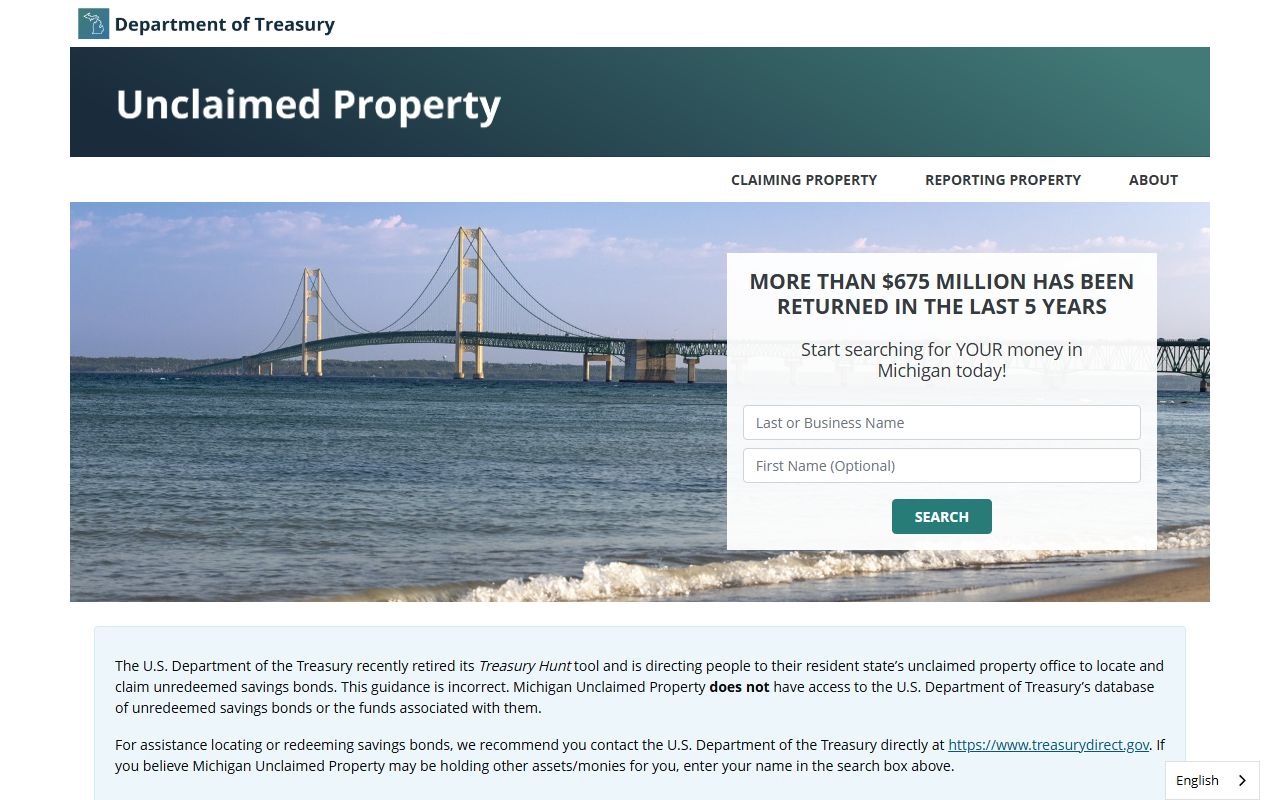
After searching the state portal, review the county-level sources described below for tax foreclosure surplus funds specific to Delta County.
Delta County Treasurer
Treasurer Sherry Godfrey operates under legal authority from Article VII, Section 4 of the Michigan Constitution, state law, and oversight from the Bureau of Local Government Services Audit Division and State Treasury guidance. The Treasurer serves as custodian of all county funds, handles accounting of all revenue, and invests idle funds in securities and financial institutions.
The Treasurer's office also handles delinquent property tax collection, reconveyance of property, certification of deeds and plat maps, and documentation for tax histories and litigation. Each year, the office conducts the annual tax sale on behalf of the State Treasury. Treasurer Godfrey serves on several county boards, including Building Authorities, Parks and Recreation, Library Boards, Local Development Companies, Economic Commissions, Planning Boards, Deferred Compensation Boards, Drainage Boards, and serves as Administrative Agent for Tax Administration Funds.
| Office | Delta County Treasurer |
|---|---|
| Treasurer | Sherry Godfrey |
| Website | deltacountymi.gov/treasurer/ |
| County Site | deltacountymi.gov |
| County Seat | Escanaba |
Tax Foreclosure Surplus Funds
When Delta County forecloses on a property for unpaid taxes and then sells it for more than what was owed, the leftover money may belong to the former owner. This is called a surplus. Under MCL 211.78t, property owners whose homes were foreclosed after 2020 have the right to claim these surplus proceeds.
The Michigan Supreme Court confirmed this right in Rafaeli v. Oakland County (2020). That ruling changed how surplus funds are handled across all 83 Michigan counties, including Delta. If you or a family member lost property to tax foreclosure in 2021 or later, you should check whether a surplus claim exists. The process requires filing Form 5743 by July 1 in the year following foreclosure, and Form 5744 by January 31 the year after that. If those windows have passed, the CC540 motion can be filed in circuit court between February 1 and May 15.
Michigan Legal Help explains the full process at michiganlegalhelp.org. That resource is free and written in plain language.
Note: The surplus claim process applies only to foreclosures that occurred after the Rafaeli ruling took effect in 2021. Earlier foreclosures use different forms and procedures.
Property Tax Foreclosure Timeline
Delta County follows Michigan's standard three-year property tax foreclosure cycle under Public Act 123 of 1999 (MCL 211.78). Knowing where a property stands in this cycle helps you act before surplus funds are forfeited.
- March 1, Year 1: Unpaid taxes become delinquent. A 4% fee plus 1% per month interest begins.
- March 1, Year 2: Property is forfeited to the county. Interest rises to 1.5% per month and additional fees accumulate.
- April 1, Year 3: Property is foreclosed. The county takes title if all delinquent taxes are not paid by the redemption deadline.
After foreclosure, properties go to public auction. Tax-Sale.info (tax-sale.info) lists auctions for 74+ Michigan counties and can be reached at 800-259-7470. Delta County participates in this system for its annual tax sale.
Other Sources of Unclaimed Funds
Beyond the Michigan Treasury database and tax foreclosure surplus, Delta County residents may have unclaimed funds from several other sources. Utility deposits from local providers are a common one. So are dormant bank accounts, uncashed payroll checks, insurance refunds, and mineral rights payments from energy companies operating in the Upper Peninsula.
Federal sources are also worth checking. The U.S. Department of Housing and Urban Development holds some mortgage-related refunds. The IRS holds unclaimed tax refunds for about three years before they become federal property. The Michigan Homeowner Assistance Fund (MIHAF) at michigan.gov/mihaf provides grants up to $25,000 for homeowners facing foreclosure due to pandemic-related hardship. That program is separate from unclaimed property but relevant for Delta County residents dealing with delinquent taxes.
Legal Help in Delta County
If you need help with a surplus claim or tax foreclosure matter, the State Bar of Michigan's Lawyer Referral Service connects you with licensed attorneys. Call (800) 968-0738 or visit lrs.michbar.org. Legal Services of Eastern Michigan (LSEM) provides free civil legal help to qualifying residents. Reach them at (800) 322-4512 or visit lsem-mi.org.
Note: Delta County is in the Upper Peninsula. Some legal aid offices serve by phone or video for UP residents. Call ahead to confirm availability.
Cities in Delta County
Delta County includes the city of Escanaba and the city of Gladstone, along with several townships. Neither city meets the 100,000 population threshold for a dedicated city page. For county-level records and unclaimed money searches, use the Delta County Treasurer's office and the Michigan Treasury portal.
Nearby Counties
Delta County shares borders with several other Upper Peninsula counties. Each handles its own tax foreclosure and unclaimed funds process under Michigan state law.